Category Archives: Bread

Country Bread – Hamelman Style

country bread hamelmanCountry Bread is my second bread this November for Mellow Bakers. The others are the Horst Bandel rye bread and a brioche which I am saving for the end of the month.

If you want to join in with this escapade,  you can get advice, give advice, and talk bread in general on the Mellow Bakers forum. We’re very nice and friendly, jump in at any time, bake any of the breads you fancy, either one for this month or a previous one. Then post on a blog or on the forum direct. You can upload pics if you feel like it. And if you need cheering up,  you can always visit the bread disaster thread too and see my very first loaves.

The Country Bread is a plain dough made with white bread flour, water, yeast and salt.There are no enrichments, no milk to sweeten and soften the crumb, no butter or oil to coat the gluten strands, no egg, no malts.

The recipe uses a paté fermentée, as we have done previously when making Rustic Bread, or for pizza. I quite like using old dough in new dough usually but on this occasion I wasn’t that excited by it if I’m honest, the difference between this bread and the Rustic Bread is gigantic.

sticky dough country bread hamelman

One of those wet and sticky doughs...

Tiny amounts of yeast, long prefermentation of half the flour in the final dough, fairly wet, quite a lot wetter than the doughs we have been making up to now. Needs lots of stretches and folds to bring it under control and I suspect the temperature control is fairly important too otherwise your timings go way off. Drop the dough temperature by four degrees and your proof time will need to be extended and so on.

I used my local supermarket, Waitrose Organic strong bread flour for this bread. You need something with a reasonably good gluten level to cope with the long prove time.
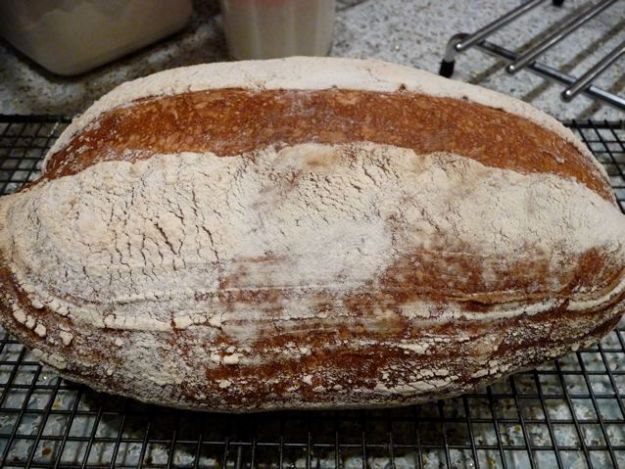
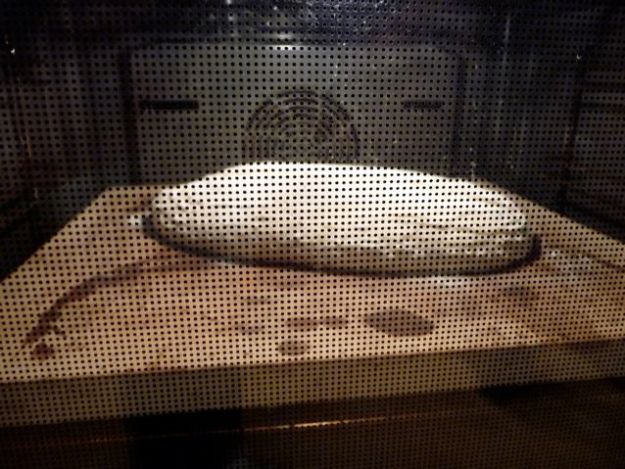
The loaves I made here are certainly good enough to eat, but in a way they remind me of loaves I made when I started out. They stuck a little in the banettons, probably because I dusted them with wheat flour and not rye flour and they spread a lot when I inverted them onto the peel, the knife dragged when I slashed them so I knew they weren’t going to open up properly. They recovered fairly well in the oven; the Angel of Spring doing her thing as always.
If this had been one of the first breads I had made I would be really pleased with this – but I know I can make better tasting bread than this. So before  anyone says, oh they look fine, I agree!  Yes they do look fine and rustic and all that sort of thing, I am not complaining, just telling you how it tastes from where I am, the photos don’t tell the whole story after all and sometimes the photos make the breads look better than they really are.

Great texture, shame about the flavour

Taste wise:-  This is a bland bread with a good open crumb, irregular holes and a chewy crust. Maybe it needs a little more salt, maybe I should have added some of my sourdough starter to it to give it some flavour, it needs something, the long pre-ferment didn’t do anything for it tastewise.

The biggest effect of the long pre-ferment and proves is on the texture of the bread, which is very similar to what one get with a white sourdough. So if you want a bread with the open, slightly chewy texture of a typical sourdough but a very mild flavour this is the one for you. It’s not the one for me. If I’m going to spend that much time monitoring a dough, stretching and folding and so on, I want to get great bread, not just a good enough bread.

… Looking forward to making that brioche, a few quick marches to burn off the calories first…..
Westphalian Pumpernickel by Post

Bread all over the place

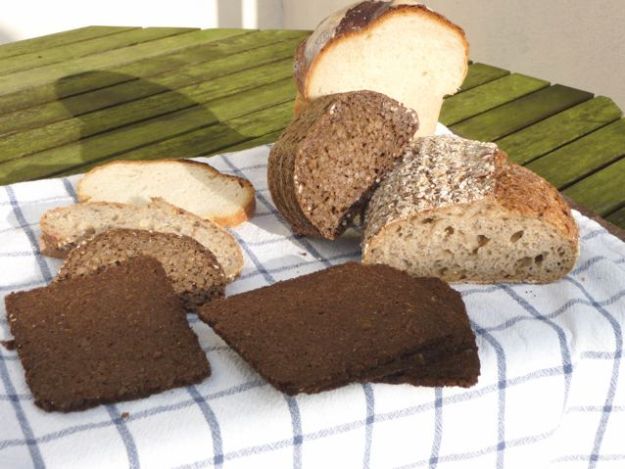
Here is the current crop of breads at home spread out in the watery November sunshine between showers of rain.

From back to front:

Dan Lepard’s delicate milk loaf, good for toast, holding poached eggs and Brian’s favourite white bread.

A 7 seeded bread from Marks Bread in Bedminster. I’m working my way through his breads to see what they are all like. This is one is a nice, nutty seedy bread.

My Horst Bandel rye bread – you’ve met before!

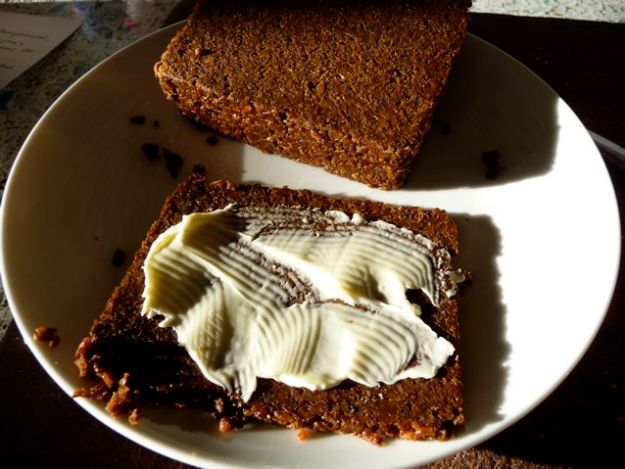
Westphalian Pumpernickel kindly sent to me by Ulrike who is a Mellow Baking friend for me to compare with the Horst Bandel rye bread.

I eat them all but Brian will only eat the first two and he is not too sure about the seeds, though he will eat rye bread if it has caraway in.  So I couldn’t ask anyone else’s opinion here. I am not particularly good at describing tastes but I will give it a shot…

Taste test

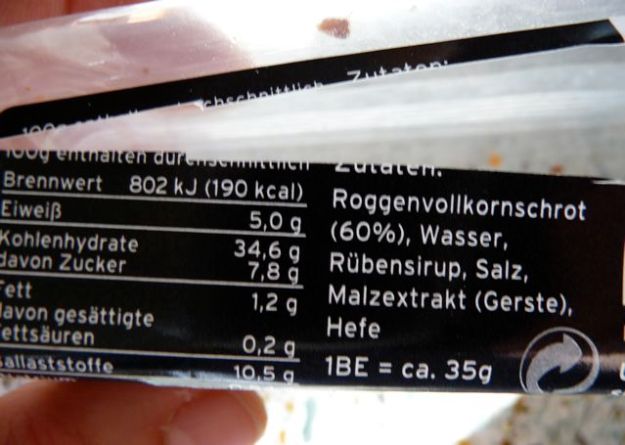
What's in the Westphalian Pumpernickel?

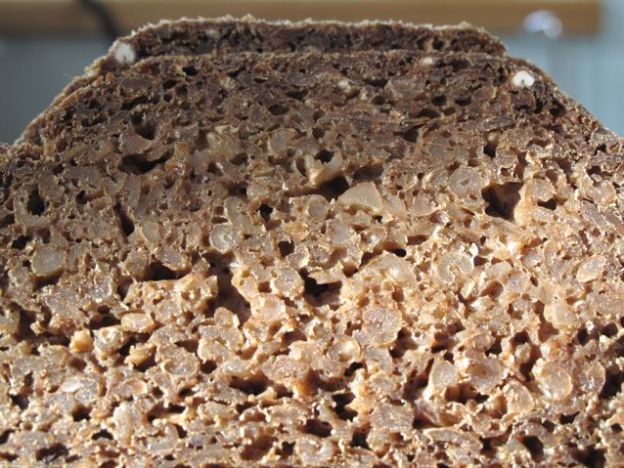
Pumpernickel to a German bread eater means exactly this bread, dark and sweet, soft and dense, made only of very coarse ground rye (meal or Schrot), molasses, malted rye,*  water, salt and yeast and baked for a very long time indeed. Looking at this bread it is quite distinctive and it has a unique texture and taste.

At a guess it doesn’t include whole grains soaked and boiled like the Jeffrey Hamelman bread.

Pumpernickel close up

Taste wise I am biased towards my own breads. I think that’s because I am used to them.   My version of the Jeffrey Hamelman recipe is more chewy and grainy and it has a sourer taste too, which might be down to the long second prove it had this time round. It is not as sweet as the traditional pumpernickel, but then it only baked for about 5 hours as opposed to 20! My bread reminds me of the Danish and German Vollkorn breads more with its paler colour and chunkier texture.

What’s really interesting is I just Googled to see what was available here and look here is an export Pumpernickel from the same  German company with an English label which is slightly different. It doesn’t mention molasses and has slightly less rye content. Do you think it has been ‘tweaked’ for the English market?  I know all manner of products are changed slightly to make them more acceptable when they travel abroad, it looks as if pumpernickel does that too.

I have a similar reaction to Ulrike’s when I come across bright orange plastic cheese called Cheddar in, say, a Canadian supermarket. But apparently my Cheddar is only one sort of Cheddar, my sort has a special title  ‘West Country Farmhouse Cheddar’ . OK, I didn’t know that, thanks Wiki!  I suspect that not many people outside the food production world know that certain names are protected or have to be phrased in a particular way. Cheddar is just another word for a medium hard cheese to most people.(My favourite Cheddar ever by the way is made by Keens with unpasteurized milk.)

A little Keens Cheddar on Beer Bread

Only cheese produced and sourced in the English counties of Somerset, Devon, Dorset, and Cornwall may be given the Protected Designation of Origin name “West Country Farmhouse Cheddar”.[3]

Maybe they should do the same for Westphalian Pumpernickel? I am sure it would count as a TSG if not a PGS. You can find out more about this complex area of protected names here on Wikipedia. I looked up Pumpernickel on the DOOR database but I couldn’t find it, though I did find Nurnberger Lebkuchen !

Do you have a treasured foodstuff that has been changed completely in its travels across the world?

Edit : * Jacqueline has given a great translation of the label below in her comment. Thanks Jacqueline!
Horst Bandel Crumb rye bread

Hamelman’s Horst Bandel Rye Bread in a Milk Loaf Tin

Horst Bandel black rye pumpernickel Jeffrey Hamelman

Photo by Brian

It’s that bread again!  (the long slow baked rye grain bread with the great back story in Bread by Jeffrey Hamelman) which is one of the Mellow Bakers November breads.

I posted my last year’s version of this a little while ago but I have made it again – practice, munch, practice. It’s fun!

A little Swedish Kaviar

I had a long think about how you could manage this bread without a pullman. I think the answer, (and I will make it a third time to test it out by the end of the month I hope)  is to use a regular loaf pan and once the dough is in the tin, grease and flour a sheet of foil, and  place it over the top of the tin and either wrap the whole tin in foil tightly or tie it on with string round the rim of the tin. Alternatively if you don’t mind what shape your bread comes out, use any bake proof container that has a sealable lid, so a pudding basin or a cast iron pot or something like that.

Mise en place

The key thing is to keep the moisture in during the long gentle bake.

My other tips are

Rye grain

Raw and Cooked Rye Grain

  1. Make sure the grains (use wheat if you can’t get hold of rye) are well soaked and really well cooked so they are plump and moist and soft. They act as storage for the water during the bake.
  2. Old Bread Soaker

    Slice the old bread thinly and bake it a bit more in the oven before you soak it. Only use as much water as you need to cover it; you are only going to have to squeeze the water out later after all.

  3. The hardest bit is judging how wet to make the dough, too wet and the bread will never really dry out enough, too dry and it will be a bit chewier than you want.  That’s not very helpful but everyone’s combination of grains and breads is going to vary. I think I would want to go for a dough that I can shape into a baton that I can pick up without it breaking apart the moment I lift it from the bench, so go for firmer rather than wetter.

Another experiment revealed!

I have a milk loaf tin which has a clip on lid so I thought I would try it out in that. In my mind the bread would rise, slowly into the top half and I would have incredibly sophisticated round slices of bread, perfect for canapes.  The drawback, pretty major, of these tins is that you can’t open them to check on progress. There is a tiny peep hole in the top of the tin – once the dough is at the top you can see it. This dough didn’t get that far. I stuck a toothpick in the hole every so often to see if I could judge where it had got to, but it never got right to the top. In fact I overproved this one by about 6 hours (!) and you can see the results here. I don’t think it made any difference to the bread though, in fact it might have improved the flavour a bit.

What do you reckon to this one?

So I ended up with a half round loaf. This time it was completely cooked through and very even in texture. Still not as dark as I would like it to be to justify being called ‘black rye’.  I like the taste, much milder than I thought it was going to be; sweet and nutty and very fragrant.

Horst Bandel rye bread

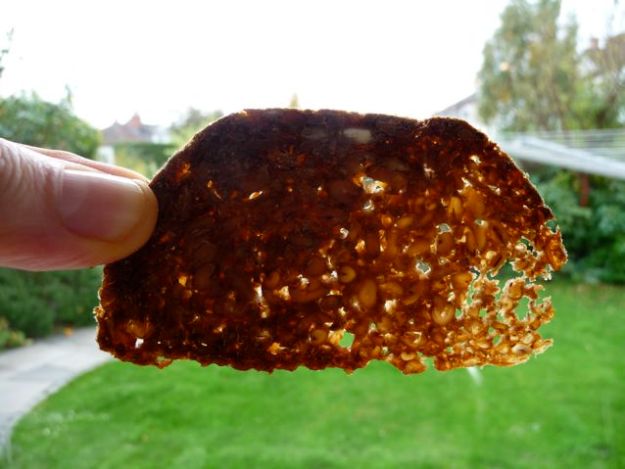
Zeb's windowpane test!