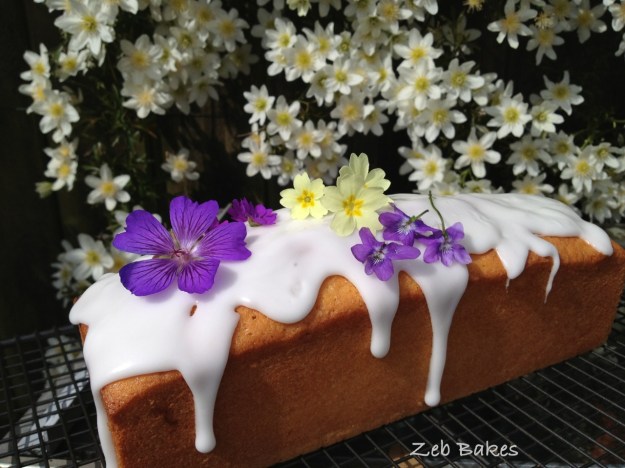
I make a cake maybe once a month or so – I try not to eat all the cake myself but share it with people. We had a very nice coffee and walnut cake last time which took me forever to make as I cracked a whole bag of walnuts to do it, as the prepacked ones in the shops always look and smell rancid to me and today for tea we had a lemony Madeira cake from Pam Corbin’s Cake book.
I used a narrow based high sided Matfer tin, the one I use mostly for making high rye tinned breads which holds a litre of water, so I hoped that is what Pam Corbin meant by a litre tin. Most mysterious.
This produces a nice slim cake, with the possibility of lots of small slices.
I adapted the recipe to use a proportion of Light at Heart stevia sweetened sugar and, oh horror of horrors, some Stork margarine, curious to see if I could taste either if I only used a bit of each. Well I can’t taste either of them in these proportions. So I can hear you thinking, what next? Is she going to go all processed food on us? Is she going to start making cakes with coconut oil and icecream from cauliflower? Who knows? I might, but I think it is fairly unlikely.
I don’t like Stork and I don’t like margarine but I know lots of people who prefer the taste of both to butter. Cake is cake and infinitely adaptable.
So for my version of this cake, perfect for a lunch box or just for carving small slices off at random and as necessary
Lemon Madeira cake adapted from Pam Corbin’s recipe in Cakes
- 200g of self-raising flour
- 100 g unsalted butter
- 50g Stork margarine
- One large lemon finely zested
- 1/2 tsp of Sicilian Limone essence from Bakery Bits
- 4 large eggs
- 100 g of organic granulated sugar
- 25 g of Light at Heart
- 2 tablespoons of lemon juice
For the icing
- 100 g icing sugar
- lemon juice as needed and a bit more Sicilian Limone essence
And then it is the usual thing of beating softened butter with sugar till light and fluffly, mine always looks wet and fluffy, not sure why and mixing in the zest and limone essence.
At some point I give up and get to the nitty gritty of the affair. I advance towards the hurdles of adding the eggs one at a time with a few teaspoons of flour with each one, Very similar to hurdles at which I was rubbish at school I may add. I warm the eggs first and wish very hard that they don’t curdle. I am getting better at it slowly, but my heart is always in my mouth and my brow furrowed slightly while I do this.
Usually somewhere just after the first egg has gone in, I remember the tin, in fact I have a minor tin panic attack and rush around pulling tins out and staring at them as if I hope they will speak to me and say ‘Me, me, pick me’ but they never do. Remember to turn the oven to 180 C (conventional electric not fan) /Gas Mark 4 if I am on a winning streak at this point.
I went for my old Matfer tin, greased it with butter, and popped a symbolic piece of baking parchment in the bottom. Turned the oven to 180 C/Gas 4. Did I mention nothing has ever stuck to this tin so far. The silver lining of my sometimes dark and thunderous cake making attempts is this tin and a couple of others. If you have a tin that won’t let go of your cakes, let go of the tin, you won’t regret it, I promise. Sorry where were we?
Oh yes fold in the rest of the flour. Add a couple of tablespoons of lemon juice, Wince a bit more, waiting for the cake mixture to scream and separate. Feel slightly disappointed when it doesn’t curdle for once.
Plop the mixture in the tin, set the oven time for 40 minutes, long narrow tin bakes quicker than a more traditional low slung loaf tin. Leave to bake, test with wooden stickie thing. Take out. Leave to cool in tin for ten minutes. Tip out onto cooling rack…
Next day.. mix up 100 g of icing sugar with a little lemon juice and plop it on the top. Go out in the garden and in a homage to the seriously good cake makers out there, pick some primroses, violets and geranium flowers and stick them on the top. Don’t they look fancy?
To those of you who have read this blog for a while a big apology that I still have mild panic attacks about making cakes, I think it is something to do with knowing that the ingredients are much more costly than for making bread and therefore there is more pressure on me to get it right, also there is in my eyes at least more that can go wrong. I don’t trust that the process will replicate itself each time I do it and while a slightly misshapen loaf is charming and rustic, a sunken cake that has left a big chunk of itself in the tin is just sad.
Find a pretty spot in the garden to take a photo and test at teatime. Well, it’s cake innit? Mine all mine, and even with those suspicious ingredients, still far nicer than most cake you can buy in the regular shops. And you can’t buy fresh flowers in a packet…
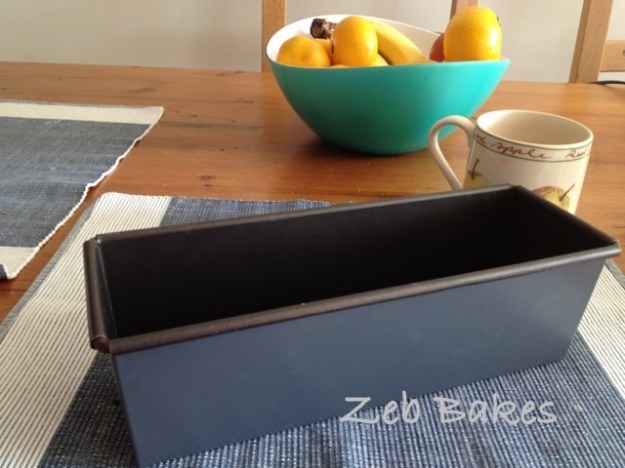
PS As there is a little bit of interest in the Matfer tin I used, judging by the comments, here it is:
They aren’t cheap, but it has lasted and looks almost as good as when I bought it. It measures 10” x 3.5” (250 mm x 85 mm) around the top, narrowing by half an inch at the base. It is 3.25 “ deep and is deceptive in that it holds around 750-800g dough / a litre of water. It has a rolled edge and sharp clean corners. I also have the smaller sized one of these which holds approximately 400g dough.



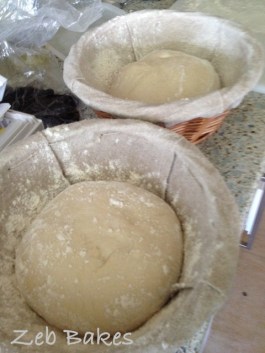 The second prove was a leisurely five hours in length and could probably have gone for another hour I suspect.
 Zeb Bakes