Warm milk, bread flour, a little cornflour, a little wholemeal, salt and yeast together yield a soft and tender loaf that toasts beautifully, makes great rolls and has a lovely colour. It’s not sourdough and I’m wondering if you add cornflour to a sourdough loaf whether you will get the same soft crumb… I’ve added the ingredients list at the bottom of the page.
Not had one of these in the garden before!
This little being is a white wagtail – we usually get pied wagtails in our towns, but not these. We get a grey wagtail sometimes, they of course are yellow bellied. This morning saw one of the jays from the woods come into the garden as well as the usual gang of finches, tits and starlings. The wood pigeons are getting fat, they will become sparrowhawk food if they carry on eating all the food we put out.
Better late than never!
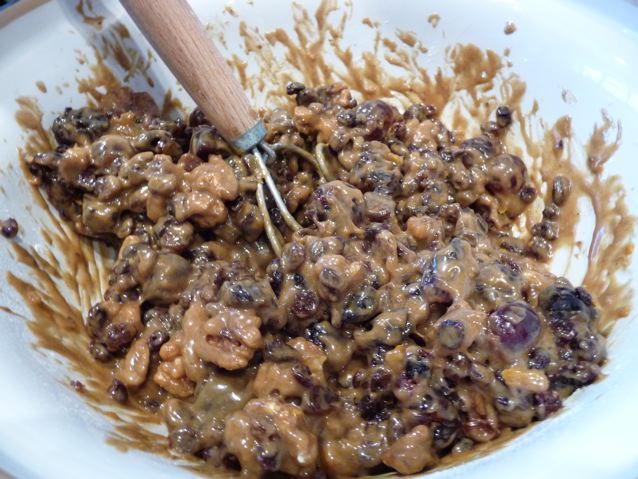
Christmas cake, christmas cake, mix and put in tin. This is Mr Lepard’s caramel cake and I baked it today. I really enjoyed the bit where the cream hits the caramel and turns to liquid fudge. I quite wanted to stop there and just eat the whole lot with a spoon, but I didn’t…
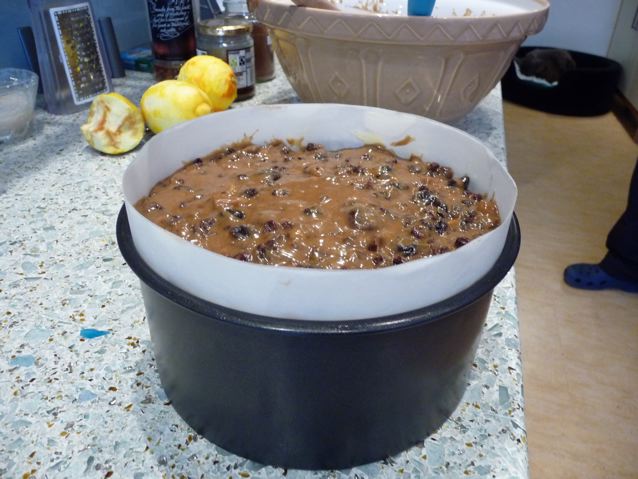
Glad I used a deep tin and made a cuff for this one
This is an 18 cm diameter tin and the recipe came to the top exactly! The cake survived baking and I will think of something to put on the top tomorrow. I’ll tell you what it’s like when we cut it.
PS: Someone asked me how to make this bread. It’s pretty basic but here we go….
Zeb’s golden toast bread:
520 grams of full fat milk warmed to at least room temperature (aiming for a dough temperature of about 76 F)
700 g strong white (bread) flour
50 g of cornflour
50 g plain wholemeal flour (not the strong sort, but the sort you use for pastry)
16 g sea salt
15 g fresh yeast or 1 sachet of active instant yeast
1 tbsp barleymalt (optional – gives a nice colour to the crumb and some easy food for the yeast)
Mix dough in your preferred manner. I used a Kenwood this time. Milk in first, followed by yeast, barleymalt, salt and flours. You should have a medium firm dough that is easy to knead. Mix for about 3 minutes on lowest speed. Hand knead briefly and into lightly oiled bowl to prove for ninety minutes. Divide the dough into two, shape 650 g boules, final prove in 750 g size round bannetons, until doubled, dusted with flour. Bake at 220 C for 30 minutes, reduce temperature to 200 C for 10 minutes more. Cool on rack. This dough will also give you a nice baker’s dozen of 100 g rolls.
Another December bread for Mellow Bakers – I was going to leave this one for another time but found myself doing it anyway, encouraged as always by the enthusiasm of my friends!
I freely admit to having massive dough anxiety about high hydration doughs full of bubbles, heaving and slithering around the worktop, it reminds me of the fear I felt when I first watched Mickey playing The Sorcerer’s Apprentice in Fantasia on the big screen in Leicester Square at the age of four, just makes me want to close my eyes and wish hard that it will all go away.
The first time I tried this at home, it all fell apart when I tried to shape the dough, tucking the sides under and ending up with enormous seams of raw flour in the middle of the loaves. So I knew not to do that this time, whatever else I did.
The trick is somehow to find a balance between having enough flour on the bench to control the dough, yet at the same time not letting that new flour get inside the dough pieces. I think it’s something you almost have to do wrong a few times before you can figure out how to do it right. A good soft paintbrush is very useful in this context, as are a couple of flipping boards. Flipping boards are easy enough to improvise from a piece of sturdy cardboard, ideally they have an angled lip on one side.
This is what I did:
I made a poolish the night before with
300 grams bread flour
300 grams water
a tiny weeny bit of fresh yeast about half a gram, maybe less)
Left it to bubble and heave till the next morning and as the sun luridly lit up the winter sky…
… dissolved 10 grams of fresh yeast in 430 grams of warm water, added that to 700 grams of flour, 19 grams of sea salt and started to mix. My flour is pretty thirsty so I added more water, which I didn’t measure, until the dough was loose and soft, no point in making something like a baguette, which is how the dough felt when I first mixed it, far too tight. So sorry Mr Hamelman but my hydration was considerably higher than you suggest, at least another 50 – 150 grams of water on top of what was in the formula and maybe I should have done more.
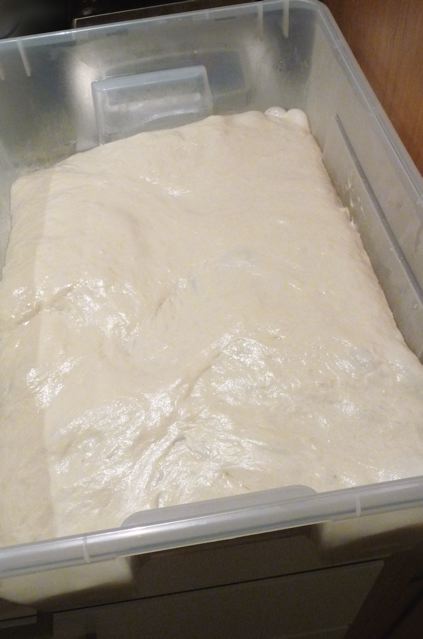
Oiled an Ikea box, poured the dough in and put in the airing cupboard. Folded after half an hour, bubble bubble, and again after a half an hour, then left it for an hour, another fold, and then after one more hour (three hours in total) the fun began.
The dough was heaving and frothing like an underwater whirlpool full of giant jellyfish. After heavily dusting my board I poured the dough out, sprinkled more flour on the top and cut it with a dough cutter into pieces. I narrowly escaped the whole lot flowing onto the floor and making a run for the door at one point. Life can be too exciting in the kitchen sometimes.
Calmly throwing flour everywhere, including all over my shoes, I got the situation under control though.
Given that one is trying to preserve the bubbles to get that open and airy crumb that one associates with ciabatta, I decided not to scale the dough. (That’s what I tell myself now anyway as I write)
I cut the dough into rectangular pieces and handling them as lightly as possible, tried to straighten them up a little. I like ciabatta to look casual, I don’t expect to have perfect rectangles which is just as well as I don’t think I could make them!
They got proofed where they were, I wasn’t crazy enough to push my luck, and plopped more plastic boxes over the boards and then after an hour or so, having heated the oven to 240 C I used my little flipping boards to get them onto floured parchment paper on trays with a flip and a flop as fast as I could and into the oven.
Baked for about 35 – 40 minutes with steam. I cracked the oven door after about 25 minutes to let the steam out.
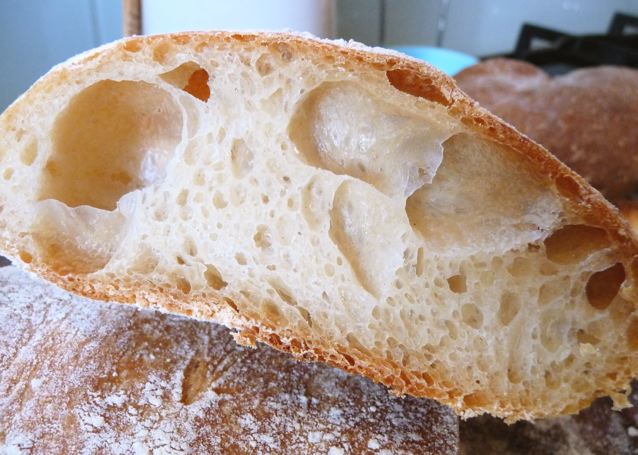
The crumb definitely has that ciabatta mouthfeel, open and airy, the crust thin and crispy. The holes could be bigger, but given that my objective was just to get through this formula in the first place, I was quite content. The damson jam fell deliciously through the holes when I had a little toasted for breakfast. The ciabatta is perfect with cream cheese and beetroot relish. Happy again!
I do think the bread would have benefited from going in on a hot tray or stone as there is a heaviness along the bottom edge of the crumb which you can see clearly, but that would have involved more moving of the dough and I wasn’t up for that. I could maybe have extended the final proof by half an hour or more. All things to consider next time!
Anyway I feel less like Mickey and more like someone who can handle wet dough, nothing like facing up to your demons. Now I really want to make this again using a softer flour; I have some T55 in the garage which could come out to play next time!
A little bit of sidetracking here ….. I am not a huge Queen fan normally, but Tipsy Mcboozerton (what a great name Tipsy) has done a fantastic job on the original cartoon posted on YouTube… and if you want to see the magic in the skies this winter, have a quick peek at this totally beautiful diamond dust sundog extravagansa on Les Cowley’s wonderful site. Another kind of magic!
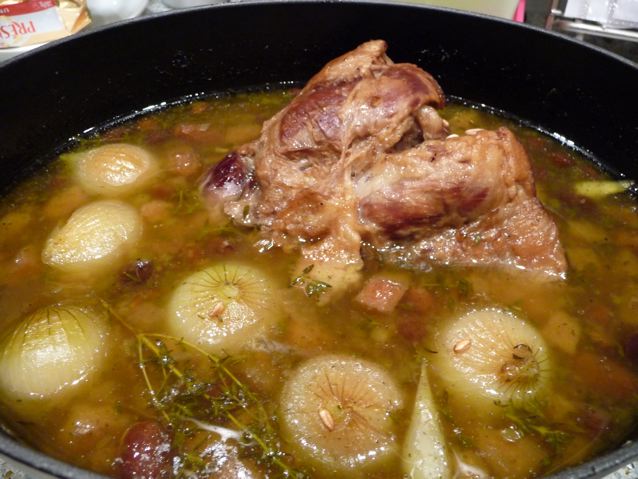
The run-up to Christmas and those big meals is often a bit of an odd time and a hearty stew is one way to make something you can eat for a couple of days at least and keep out the cold!
This week I made this dish using half a leg of mutton from the Thoroughly Wild Meat Company. Andrew Moore raises lambs on the salt marsh and produces exquisite lamb. He is incredibly knowledgeable and helpful. You can find him at the farmers’ markets in Bristol and Bath which is where we met him.
When Andrew told me he was having mutton from his sheep this autumn in addition to the lamb, I shared a box with Gill the Painter, an event involving a meeting in Gloucester Cathedral and a shopping bag on wheels…. felt like we had escaped from an Alan Bennett short story. Here is Gill’s balsamic leg of lamb recipe which she used on her mutton.
Here are my notes – easy to do if you have time and plan a little ahead.
Brown your lightly seasoned meat in a little oil in a large casserole on the hob. Once nicely browned add as much stock as you need to come at least three-quarters up the meat. I used a mixture of vegetable stock and some lamb stock that I had saved in the freezer. Fresh thyme is a good herb to use with this dish.
Squeeze two lemons and add the juice to the stock. We also threw in a jar of home-made fruit chutney . We weren’t quite sure what was in it, as it hadn’t been labelled, but probably it was raisins, apples, pears and onions in cider vinegar and spices, to give you an idea of what you might use. Maybe a little wine if you have any opened bottles could find its way in there too.
Bring to a gentle simmer on the hob. Cover and place in a warm oven for 3 hours. You will need to check the meat every hour or so and turn it over. Someone turned the oven down at some point, so we ended up cooking the dish for nearer five hours but you will know your own oven best. Once the meat has cooked and softened, add small whole onions and return to the oven for another 45 minutes or so. Then add 50 grams of spelt (farro) per person, check seasoning, cook for another 30 minutes. If you don’t have spelt, then try barley.
Serve with carrots, Brussels sprout tops or any tender green cabbage. You can either take the casserole to the hob and steam the vegetables on top of the stew, or steam them separately.
You can eat this one pot meal as it is, or serve with some fabulous bread to mop up the rich citrussy juices. Watch out for the onions as they explode when you bite them!
If you want to reduce the fat content of this meal, (and mutton can be fatty if you are used to eating very lean meat) the best thing is to cook the meat the day before, and allow the whole dish to cool so that the fat can be taken off the top. Add the onions and the spelt (farro) the following day.








 Zeb Bakes