
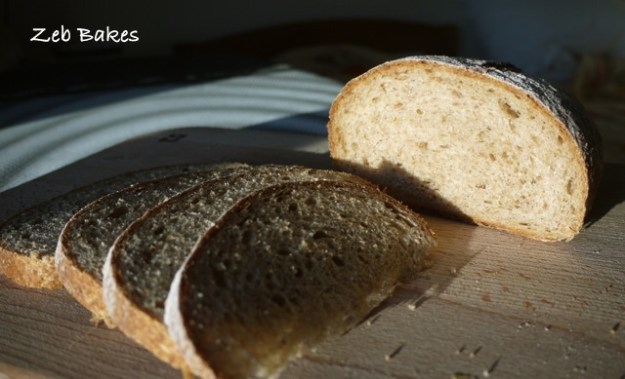
Category Archives: Bread

Dan Lepard’s Wholemeal Bread

This week is the wholemeal bread challenge from Short & Sweet. You can find Felicity Cloake’s version of this recipe here on the Guardian website in which she explored different ways of approaching the wholemeal loaf and ended up liking Dan’s the best.

I made two different loaves this time; Dan helpfully writes up the recipe saying it is a starting point to finding the loaf you are happy with.

Once you have had a go at the basic one, you can move on to exciting variations like ale and spelt and unleash the creativity of your inner bread baker! I know you have one in you or you wouldn’t be reading this!

I can eat 100% rye with great delight but something about too much wheat bran gives me indigestion. English stoneground wheat is always full of huge flakes of bran and I would rather have a finer milled German style whole wheat, though it seems almost impossible to buy here in the UK. Presumably any whole grain flour will give you dietary fibre, so you could use spelt, kamut, einkorn or emmer all possibilities for getting that fibre content into your daily bread.
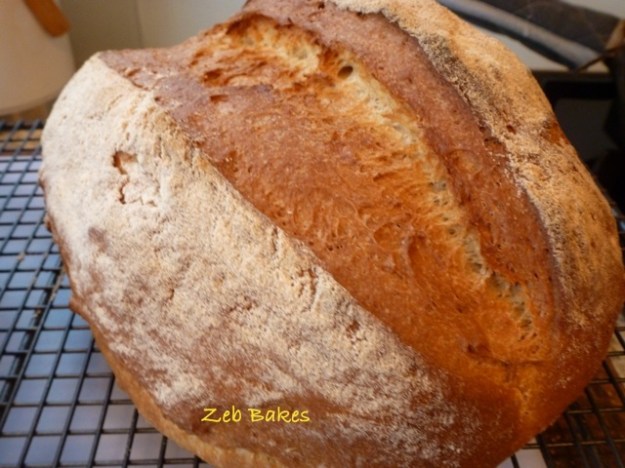
I went for a 50/50 blend of wholemeal and white in one of these loaves and of 50/50 kamut and white in the other. These breads don’t use milk, but they do use butter which improves the keeping qualities of the bread and is very traditional in English loaves.

I used regular sugar in both as per the recipe and for my money that was a mistake as I have got used to using spraymalt to sweeten Brian’s white breads and I should have used that in these. The taste of regular sugar is too much for me in bread like this, though I imagine it is there to mask the slight bitterness of the wholemeal. I wonder if apple concentrate would be nice?  It’s all about personal taste, so do vary recipes to suit your palate and experiment with sweeteners if you use them. Spraymalt is particularly nice, comes in lots of varieties, fascinating to read about it on the Muntons site.  It is fairly easy to get hold of if you have a local brewing shop or from online beer making sites and I think Bakery Bits sells it too.

The contrast in the doughs was quite marked. Dough 1 was sedate and quiet, whereas  Dough 2 with the kamut was soft and bouncy and increased quickly in volume. Despite being a high protein flour, its gluten is very different from that of regular wheat and the surface of the dough pocketed and opened up quite a lot, giving a rugged rustic quality to the finished loaf. I couldn’t get it to form a smooth sheath at all on shaping. It also sprang dramatically in the oven unlike the wheat one which rose a bit but didn’t do anything very exciting.
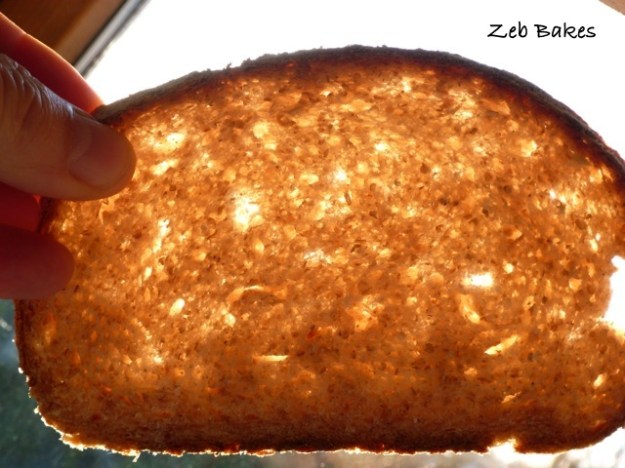
Both loaves make light sweet bread, easy for toast, very English in style. Not quite my thing but I am sure the sort of bread that pleases many people. it’s a very easy recipe for beginners to follow too, watch the timings, handle the dough gently, if you are not sure about shaping it use a tin which you butter and dust with flour and you’ll be fine.

For a forthright discussion about the role of fibre in our diets and the ramifications for children’s health in particular read Lou’s  post on Please Do Not Feed the Animals.

For the round up post for last week’s sweetie extravaganza and some fascinating links click here and have a peek at the other round ups for the Shortandtweet group. Join in any time you feel like it, all welcome!

Edit: 

Just thought I’d add a few links to other bread posts which incorporate wholemeal flour but are very different from this one….

For a sourdough bread using mainly wholemeal have a look at this old post of mine from the Mellow Bakers project with the grand name of Miche Pointe-a-Calliere. Another very good bread is this Rustic Bread which uses a mix of flours, including wholemeal to produce a very pleasing loaf and in which I incorporated some left yoghurt whey.

 Another very popular bread that uses wholemeal flour is Dan Lepard’s Golspie Loaf, one of the star breads in the Hand Made Loaf. This is one I make regularly for my neighbour who is a big wholemeal fan. There is a picture of it in this little slideshow post.

Fenland Celery and Onion Bread

Fenland Celery and Onion Braid

At the moment we are lucky to be able to get my favourite sort of celery, the old fashioned varieties which are mainly grown in East Anglia with its deep fertile peat soil.

 It is a labour intensive business to grow as it has to be earthed up in order to blanch the stems and to develop the distinctive flavour that makes it special. It has a sweet nutty, almost almondy taste and it is very good.  It’s around now, so keep an eye out for it if you are in the UK.  This is my attempt to use seasonal food in my bread for this month anyway! Continue reading

Sourdough at The Loaf in Crich

I received this lovely email and photos from Anne yesterday and I asked her if I could share it with you all. So she has kindly agreed to let me post it as a guest post. 

Much to tell !

Baking Course at the Loaf in Crich

On Sunday, I attended the first Sourdough course held at the loaf in Crich, my first bread course ever.

And what a day it was !

it started with the drive to Crich in Derbyshire. After leaving the hustle and bustle of the A38, we followed quiet, narrow, windy roads, past Heage and its working windmill and up the hills to Crich. The village was still sleepy, enveloped in a blanket of fog. As I stepped through the threshold of the café, I thought I had entered a new world.

It felt as when I go back to southern France my home: as the plane lands and the exit doors open, I am engulfed in a warm comforting blanket of warmth, light, smell of my Garrigue and noise of crickets with one thought forming and dominating in my head: “I am home!”.

The café was inundated with light, cosy, the happy chatty community enjoying their breakfast.

Although the team was busy with an already important clientèle on this Sunday morning, they quickly served us with a choice of fruit juices, hot drinks, croissants and brioches.

Seven bakers were present to follow a day-long course on sourdough orchestrated by Andrew. Indeed, Andrew organised, planned the day and directed the bakers as a real conductor.

A very nice person and teacher, he passed on to us more than techniques and knowledge but his passion for the art.

Andrew was patiently demonstrating, correcting, encouraging and complimenting the bakers through each step of the bread baking process – weighing out, mixing, autolyse, kneading , rising, folding, shaping, proving, slashing, steaming, baking, and cooling.

I really benefited from being shown how to knead the French way:   until now, I had a tendency to ease my frustration at working wet sticky dough (usually 70% hydration) by adding a bit of flour on the counter. Here, Andrew even added more water to our baguette dough (!!!)  so we would understand how our vigorous slapping and kneading would start the gluten development and with it the elasticity and stretch. Reaching the point when the dough is smooth and silky was more obvious than any book description read so far.

The Crich dough with both rye and wheat leavens was prepared using the no-knead bread method. At 79% hydration, the dough was easier to work that way.

Understanding the pre-bulk was demonstrated by the 100 % rye bread: no vigorous kneading required, but learning to work with rye and judging the critical moment when the dough is ready to be shaped.

Bench rest followed by shaping: we formed bâtards, baguettes, boules and rolls.

Taken from Anne's phone! Wow look at those holes!

I have recently followed several times a Spelt and Corn rolls recipe from Dan Lepard adapted to sourdough but the polenta makes firmer dough and therefore facilitate the shaping. Rolls with the baguette sourdough excess were a different matter: I had to  understand the dough more and look at it: its aspect, its elasticity and how these are affected by how long/how we shape, how much flour on the work surface and our hands.

Slashing: That takes practice ! and practice and practice ! and obviously, I have not practiced enough on wet dough.

Many questions were asked always answered with expertise and honesty: bread baking is a science and who knows exactly what those millions and millions of wild yeast and bacteria will do! It was obvious that Andrew had more than techniques and books to share but also true passion, He presented different ways to work: machine or hand-knead, low / high hydration levain and its effect on flavour and acidity, wet dough or not depending on how aerated you want your bread to turn out. Never too technical or overly scientific but always all easily explained.

It was after 5 by the time our loaves were out of the oven and cooling. Andrew had been up since 5 o’clock in the morning but was the only one still alert: all seven amateur bakers were exhausted!

On Monday, his day off, Andrew will be busy baking in preparation for Christmas. With cafés in Crich and Matlock, supplying to wholesale, participating in weekly markets and Christmas market, organising many bread courses, one wonders what is next!

For me, I will wait impatiently all week until I can finally on Friday evening take from the fridge this magical starter and as it feeds on flour and water, it will come alive again.

In the meantime, I will enjoy savouring those lovely loaves baked at The Loaf !

Enjoy your week!

All text and photos taken by Anne and shown by permission.