Category Archives: Plant identification

Rocoto – Capiscum Pubescens – the hairy chilli from South America (updated with additional photos Dec 17)

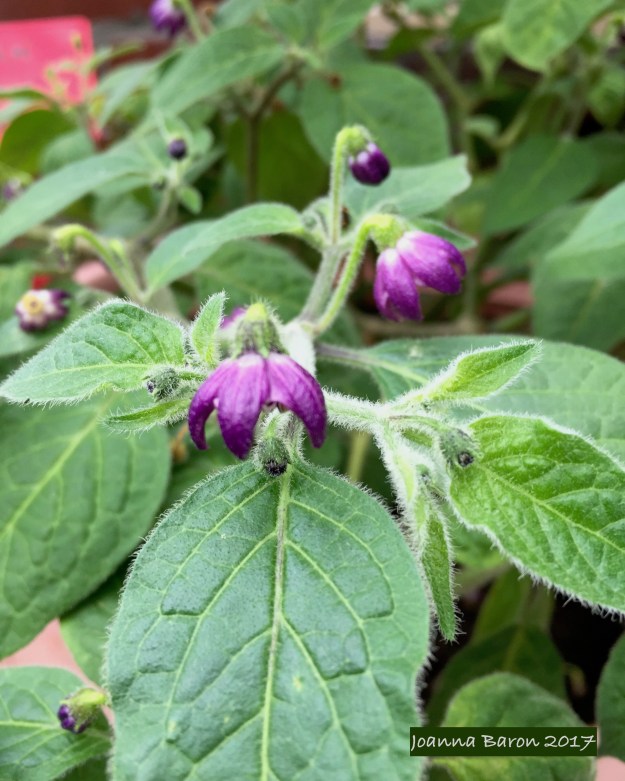
RocotoThis rather gorgeous chilli plant is known in Peru as rocoto. Sometimes it is called the hairy chilli, think of a pubescent boy! And Wiki tells me it will have black seeds which distinguish it from other species of chilli. Thanks to Rhizowen for confirming the id too!

It will overwinter providing it is protected from frost and its stems become woody, so it is also sometimes called a tree chilli and can live up to 15 years!

Neil and Jo were lucky enough to be gifted a two year old plant by Henleaze Garden Shop  for Blaise Community Garden – HGS is an independent garden centre where the owner and  family grow all sorts of unusual plants in their greenhouses , sharing Neil’s chilli passion – at the back of the shop – and thus are able to offer something different to their customers as well as the stock that comes in from nurseries. Henleaze Garden Shop is next to the Tesco garage on Henleaze High Street and always worth a visit as it is packed with plants and is a genuine local family business.
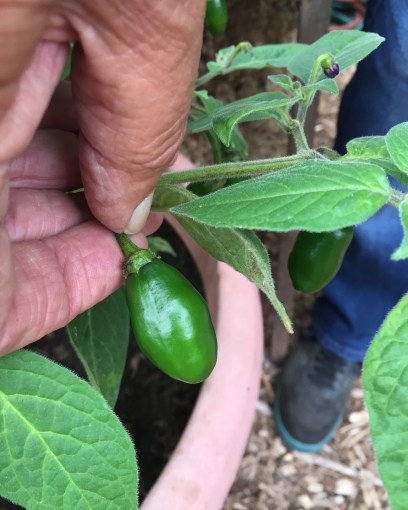
rocoto fruit.jpg

The Blaise plant is being lovingly tended by Neil in Greenhouse 1 and at the moment is flowering and setting fruit. When fully ripe the fruit will be red and resemble a small bell pepper. Jo has been told it is a hot chilli with a short burst of heat! Can’t wait to try it!
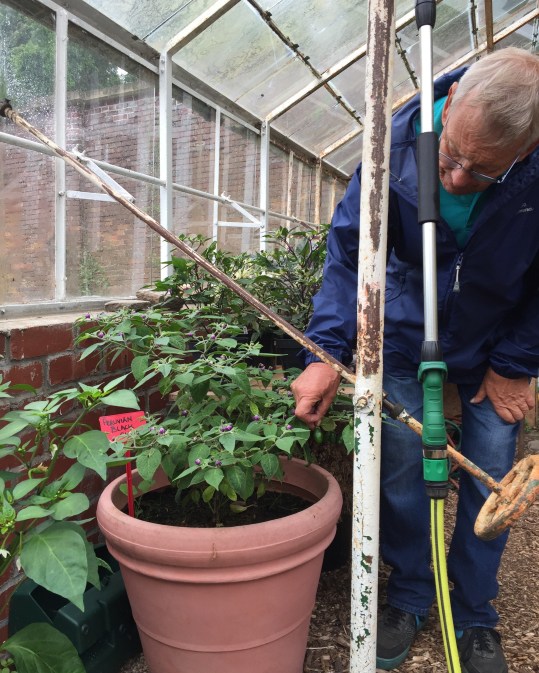
Neil.jpg

From Wikipedia :

Like all other species of the genus Capsicum, plants of the species Capsicum pubescens grow as a shrub, but sometimes as climbing plants. They grow into four-meter woody plants relatively quickly, and live up to 15 years, which gives them, especially with age, an almost tree-like appearance.[10] After a first impulse is formed, the plant branches at a height of about 30 cm for the first time, and forms during growth by further dividing into a bushy appearance. More shoots develop from the leaf axils. Some varieties have purple discoloration on the branches, as can be observed in other Capsicums pecies. The leaves have a 5–12 mm long petiole and a leaf blade ovate to 5–12 cm long, 2.5 to 4 cm wide, tapering at the top and the base is wedge-shaped.[11]

In addition to the relatively long life, Capsicum pubescens differs in many other characteristics from related species.

Flowers

The flowers appear singly or in pairs (rarely up to four) on the shoots, and the branches are at about 1 cm long flower stems, which extend on the fruit to around 4–5 cm. The calyx has five triangular pointed teeth, which have in the fruit a length of about 1 mm. A characteristic different from other cultivated species of the genus Capsicum is the blue-violet-colored petals, brighter in the centre. The anthers are partly purple, partly white.[7]

PS  I found this on the Scoville Scale ( I am growing Anaheim at home this year because I am a wimp!)

Image result for rocoto wiki

Joanna Baron July 2017


Update December 2017

I thought I would update this with some photos of the ripe fruits and a simple recipe for making a red pepper sauce which you can make as hot or as mild as you like and then freeze in little quantities for later use.


By the end of August the first of the fruits were ripening and ready to harvest. The plant was heavy with fruit and its stems would snap off occasionally under the weight.

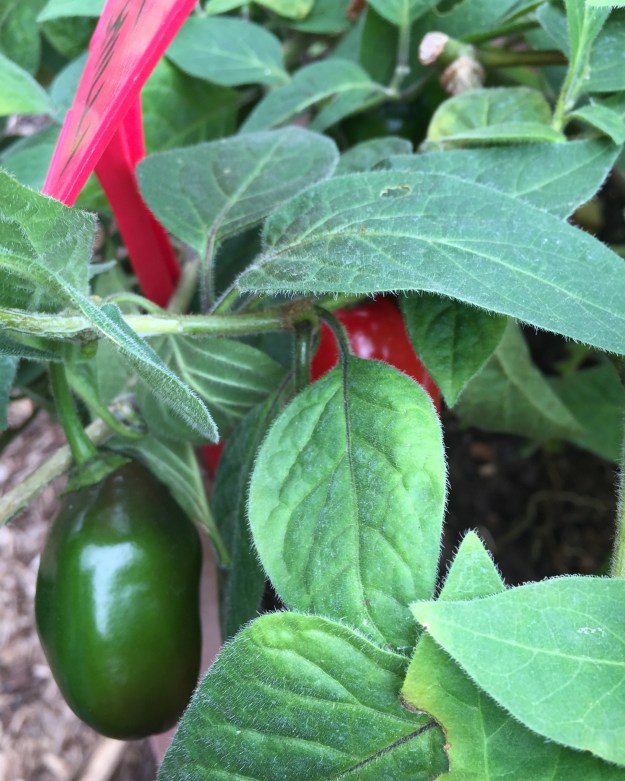
They are ovoid and smooth and have thick fleshy walls and black seeds

I dried some of them for Neil using a dehydrator, cutting them in half as otherwise it would take forever.
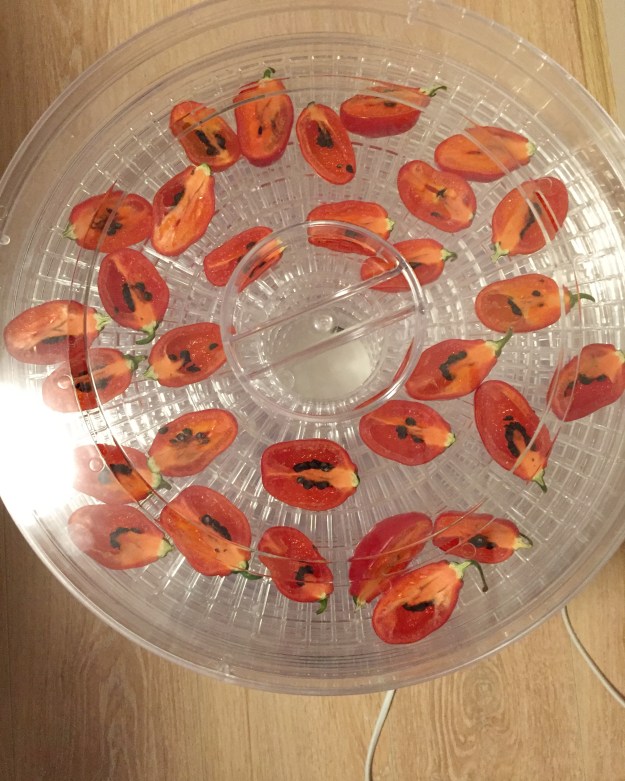
 

and I made a version of Turkish pepper paste with just one of them (!) and about a kg of sweet red peppers. To do this you roast the peppers and the chilli whole in the oven till the skin is blackened and soft, skin the fruits, and remove the seeds and then pulp the roasted flesh to a smooth paste, add salt to taste, spread on a tray and put back in the oven to darken and become thick and sticky. Then scrape off the tray and store in little pots. It is a fabulous base for dishes like Enzo the Bride red lentil soup, recipe in Sally Butcher’s Veggistan book,  adding sweetness, piquancy and heat.

UK National Fungus Day

Bread in Morning Light

Sunday 13th October 2013

Some bread out of the oven cooling in the early morning sunshine.  The one in the front is in reality very small but because of the way the camera works it looks quite big. Thanks to the kefir and whatever yeast (fungus) we use we have bread and can make our own as human beings have been doing for a very long time now.

Fungi and bacteria work with the building blocks of the living world to create and destroy. The more we learn about how they work the more amazing they turn out to be. Maybe we should have a National Bacteria Day too?

Here are some of this autumn’s crop of fungi photographs, taken at Westonbirt, Glos and in the Forest of Dean, which is on the other side of the Severn Bridge, but on this side of the border with Wales. It is a good year for fungi in the UK, so have a go at seeing what you can see, or go to an organized walk or a talk, lots around ! This is the first UK Fungus Day and I think it is a great idea!

I have had a stab at identifying some of them but as ever warn people not to go by my identification as I am not a mycologist. I used to be quite reasonable at identifying about a dozen or so of the edible fungi, but as the years pass I have got out of practice. If you go on a fungi foray with a group or a self-styled forager be sure to ask them how they learnt their trade and ask lots of questions. In these straitened economic times, people turn to all sorts of ways to earn a living and foraging and ‘teaching’ foraging is one of them.

For most of us, wild fungi are not an essential part of our diet, but rather a treat, a flavour, an aroma, something maybe that one wouldn’t desire if not driven by media hype and an urge for different experiences.

I am not saying don’t or that it is wrong to want to taste and touch new things, just be extremely careful. There are cases of poisoning each year, usually well-documented in the press, of people who eat the wrong fungi, or the wrong berries or plants.

What is fun and completely safe however, is to go out and take photographs and look for them. We are sticking to that this year unless we see the ones that I know I can id positively.

And not to create any confusion, we didn’t bring any of the fungi depicted here home with us, only took their photos. Please do not ask me to identify your fungi finds!

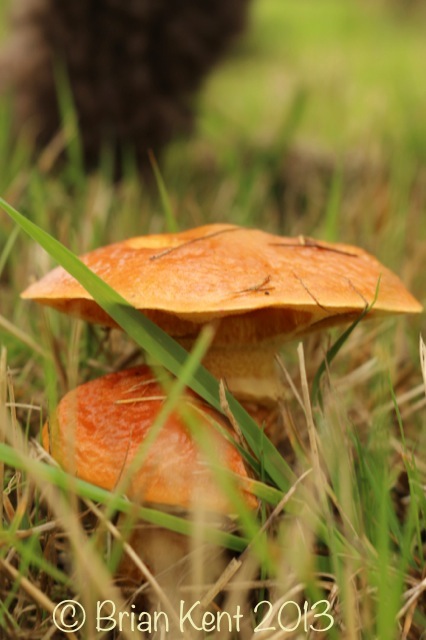
larch Boletus Brian Kent

I am pretty sure this is the larch boletus, with its spongy underside.

Yellow Stagshorn Calocera viscosa

and I think this is Yellow Stagshorn( Calocera viscosa) – because it was growing on wood but it’s not one we see very often, it is very small and delicate but has this outstanding glowing colour.

autumn fungi

Haven’t looked this one up yet…

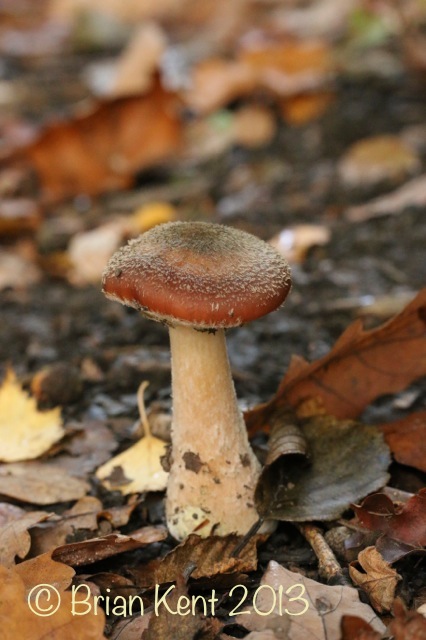
…and finally the most glamorous one we have seen this autumn which I think is a magpie inkcap but I haven’t found an image exactly like it so who knows?

magpie inkcap?

One of the hardest things is keeping the dogs out of the field of shot, as anything that interests us, interests them and we don’t want them to eat the fungi either!

Anyone want to tango with a wet poodle?

Anyone want to tango with a wet poodle?

So for those of you who miss him, here is your small friend Zeb, following an exciting jump into a mud bath on the edge of a small pool which contained a stick of desire that he had to have, (just had to).  We are taking him and his sister to the beach this coming week. I forsee many early evening baths.

Big Moon and a Frog

24th July 2013 1.29 a.m -– just now as I turned to leave the kitchen to go upstairs to bed I realised there was a frog silently staring at one of the poodles asleep on her blanket.

I was slightly baffled – the back door was shut and the frog must have come in the house much earlier in the day.  I picked up a plastic pudding basin and popped it over the frog and found He who loves Frogs and used to rescue tropical ones from the bananas when he worked in Safeways and take them home with him and look after them when the zoo didn’t want to know.

He was asleep. I woke him. I could have maybe done it myself, I know I know, but I didn’t want to. He likes frogs a lot, I like frogs, but not so much that I want to have one jump up at me, because then I would jump and we would all scream a bit and the frog would get stressed.

So the sleepy Lord of the Frogs put on his Frog Catching Gloves and airlifted Mr Green to safety. I don’t think he really woke up, he is clever like that. He will think it was a dream in the morning.

Outside there is a big golden moon sailing high in the sky. lighting up the streaky clouds.  We saw the moon earlier in the evening and did that thing where you look at the moon upside down (easiest way is through your legs)  and it looks smaller. It worked.

Inula Hookeri

This post could do with a photo or two and I don’t have a picture of the moon, but here is a photo I took the night before of a flower in a front garden I walked past. There were lots of them and they had clearly spread through the garden in a slightly invasive way.

I asked on Twitter if anyone knew what it was and kind people made all sorts of suggestions and eventually came up with Inula Hookeri. It reminds me of something you would find stuck on a bathing cap from my childhood.  I think it is beautiful.

If I walk down to the back fence, there is this stalwart shrub covered in flowers. Every year I think it is going to die in the cold winds of winter. Its leaves turn red, and then mysteriously they turn green again in the Spring and by July it is covered in sweet white whirls of jasmine scented flowers, the shrub doesn’t grow very much but it is still here eight years after being planted in a planting pocket surrounded by concrete. It is a survivor. The Clock is telling me to Go To Bed once more.

I am becoming an insomniac blogger.

Night all x

Trachelospermum Jasmonides