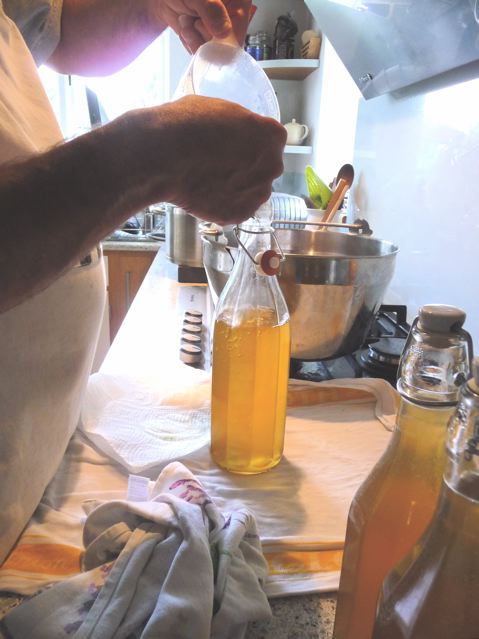
Category Archives: Recipes

Yoghurt Making (2)

An example of homemade yoghurt

This is just a quick post for those people who seem to end up here looking for info about yoghurt making.   The best results I have had so far using the Lakeland electric yoghurt maker which I have been using for about eight weeks is from the following method. Quick to set up, no saucepans of cooling forgotten milk.

  1. 2 teaspoons of fresh live yoghurt – do not be tempted to use more, it will not make the yoghurt ‘happen’ faster or better!
  2. 2 dessertspoons of non fat skimmed dried milk, something I have never bought before but the yoghurt seems to like it, what more can I say?
  3. 1 litre of UHT milk.  Ideally full fat. Morrissons 4 per cent fat performs better than Waitrose 3.6 per cent fat.

Using UHT milk means you skip all that heating it up to a certain temperature and then waiting for it to cool down again, less washing up, so offsetting the carbon footprint of using an electric yoghurt maker, also if you make your own you are reducing your packaging use.  Not sure if there is a net gain or loss but I am trying hard here.

Put the 2 tsps of yoghurt in the bottom of the container. Sprinkle the non fat powder on top. Add a little UHT milk. Give it a good stir around. Put container in the electric heater bit. Add the rest of the milk. Put the lid on. And then leave for at least 8 hours, mine seems  to take more like 9 hours to go. It’s odd stuff. You look at it and nothing happens for ages and then it goes all of a sudden.

If you don’t have a yoghurt maker then use a wide necked flask or a jug, but you will have to consider how you will keep it warm. A good thermos flask will probably work fine. Yoghurt needs a warm temperature to develop. The lactobacteria and the Streptococcus thermophilus –  the organisms that create the yoghurt –  are called ‘thermophilic’ (lovers of heat) for that reason. It needs to be kept at 100-degrees Fahrenheit (37-degrees Celsius). It will get more sour the longer it is kept warm, so that is why you chill yoghurt in the fridge once it has developed to the thickness and taste you want. It is worth doing more research on the net if you want to know more about this.

Take it out of the electric heater bit. Let it cool a while. I put mine in the fridge overnight and then put it into clean pyrex containers with snap on lids like these.

You can use the easi yo stuff in it. I have found that it splits. But when it does split, it’s easy enough to strain it through a bit of muslin in a sieve and then you have wonderful whey for baking bread,  can’t recommend this too highly, and a thick soft yoghurt that you can use in lots of ways.

Today I made rocket pesto using fresh yoghurt

My sister's recipe for pesto

I used:-


  • A big bunch of going over rocket from the garden
  • Fresh garlic
  • Grated pecorino cheese
  • Cashew nuts
  • Yoghurt
  • A little walnut oil and extra virgin olive oil
  • Salt

I can’t give you exact quantities because I basically shoved the lot in the blender and mixed and tasted till I got something I liked.  You can use any favourite herbs and nuts: this is my sister’s way of making pesto, as she prefers yoghurt to loads of oil, makes it much lighter. I store it in the fridge with a layer of olive oil on the top which reduces the effect of oxidisation.

Pesto in fridge with layer of olive oil on top in recycled container

Spread it on sourdough toast for a quick sandwich, add to pasta,  mix into salad dressings…

July 2010 – Made a lovely  lime cheesecake with strained yoghurt (labneh) made from rich creamy Jersey/Guernsey milk. Click here to read the post and the recipe.
Elderflower Cordial Part 3

At last…

The following day we studied the instructions again. One thing I forgot to say; you need a thermometer. If you are going to do any of these recipes, it is essential. That and this book and you won’t go too wrong!

Pam Corbin’s method gives a cordial that you can keep on the shelf. Other methods give a result which you have to keep in the fridge, like the Jam Jar Shop Guide to Elderflower Cordial.

The alternatives have some version of making a sugar syrup first, then adding the flowers. Some recipes add chopped up whole citrus fruit rather than zest.  That method presumably is gentler on the flowers and you might get a more fragrant though shorter lived cordial that way.  There is a risk of mould if you don’t use a sterilising water bath to process the bottles and want to keep the cordial out of the fridge in storage.

Filtration:  Brian poured the liquor  carefully out of the bucket where the flower heads and zest had been soaking overnight into another container and strained it through a muslin bag to remove particles. The liquid was very dark and we worried that we were gong to end up with a brown cordial.

Then we did some sums;  1.5 litres of liquid to 1 kg of granulated sugar plus one heaped teaspoon of citric acid were the proportions used.

We added all of the lemon and orange juices reserved from the previous day, about 500 ml, to the strained liquor, sugar and citric acid. Heated it up slowly to dissolve the sugar and then realised that we had forgotten to strain the citrus juice, so we put the whole lot through muslin again. Twice.  A mistake that could be fixed! No floaty particles now!

Our jam pan held 4.5 litres worth of liquid so that’s what we worked with.

We sterilized the bottles and  Brian carefully simmered the cordial. It stayed a murky brown. I took a spoonful and put it in a glass and diluted it to see what it tasted of. Not quite right somehow, but I couldn’t work out why.  A little bitter, a little polleny, not what I expected.

I went away to do something and when I came back Brian had transformed the cordial. The secret was buried in Pam’s notes:   it has to come up to  88° – 90° C whilst being simmered, for two minutes, this not only extends the shelf life but transformed the cordial into a paler and brighter fluid. Now it tasted right, silky, floral and citrussy. For a moment there I thought we were going to have to chuck the lot!

Much happier now, Brian proceeded to fill the bottles leaving a gap of an inch at the top for expansion in the final stage.

He then arranged them in two waterbaths, positioning the bottles so they didn’t touch the sides of the pan and standing them on folded tea towels. Tops on bottles not done up tight at this point.

The water was brought up to 88° C and kept there for 20 minutes. A thermometer is essential!

After this, he hoiked them out and tightened the tops.

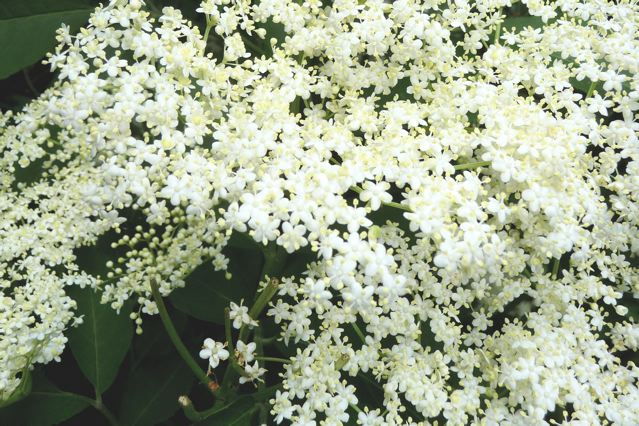
Bottles of golden June delight! I found some ancient sheets of label paper and used one of the photos as a background image for these labels.

Thank you Pam and thank you Brian, chief bottler and preserver!  A summer of delightful elderflower spritzers beckons….

Edit: Later in the month  when we were “Around and About” we made a second batch using a cold steep method. This batch was a lot more lemony and had less of the elderflower aroma too it, but had a much paler colour.

Elderflower Cordial Part 2

Lots to do…

The recipe, method and important advice on sterilising bottles all come from Pam Corbin’s wonderful and indispensable book Preserves.  There are always different ways to make something like this,  but she hasn’t let us down yet.

Unwaxed lemons and oranges are a good idea if you are planning to include zest in anything. If you can’t get them then give the ones you have a really good scrub to remove any coatings. I used organic fruit but if I couldn’t get organic I would still have a go at this. The elder flowers aren’t there all year round after all.

I treated us to some fancy bottles with ceramic tops – though not enough in the end for the quantity of cordial we ended up with –  and a jar of citric acid from the Jam Jar website last week, as well as a very important mini funnel. I think if anyone is thinking of producing this stuff on a big scale they would need to really hunt around for a cheaper source of container though and recycle as much as they can, which is what we did for most of the bottles we used. I have to tell you that Brian took over at a certain point in the process, as he loves filtering and bottling and sterilising. Says it reminds him of when he used to make beer!

My first job was to sit and inspect the flowers for insects and caterpillars. I had a little help.  We found a few caterpillars and some green bugs I had never seen before but they were surprisingly empty of visible wildlife. I was pleased about that. I then zested eight lemons and a couple of oranges.

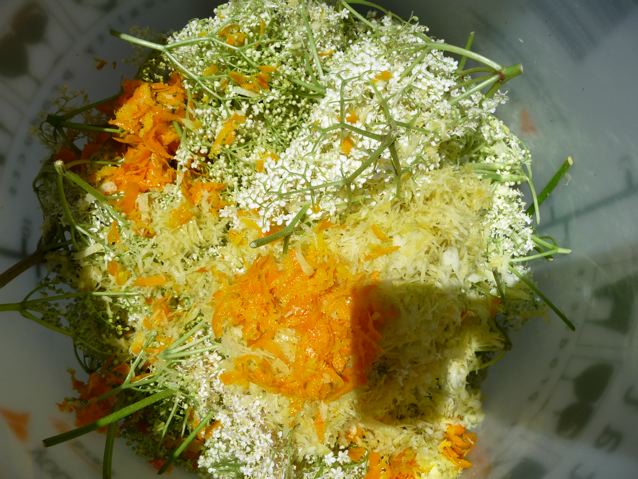
The bag of flowers, and the two lots of zest were flung into the beer tub where I admired their transient beauty and grabbed this shot.  I squeezed the juice from the fruits separately and stored it in the fridge for the following day.

Then we created a witches brew by boiling numerous kettles of water until we had enough to comfortably cover the flowers and zest.  The flowers mostly turned brown and the whole thing smelt faintly of wee and hot green stuff.  Quite scary, but one has to believe that Pam Corbin knows what she is doing and it says in the book that this is an old River Cottage recipe so we thought we can blame Hugh FW as well if it all goes wrong! We put the lid on the tub and left the whole lot to brew for twenty-four hours.

Click here for Elderflower Cordial Part 3