2nd July 2010
As I trailed around the local woodland with the dogs I looked at the wildflower meadows planted by the schoolchildren a few years ago and thought that I must get better at flower identification. It’s on my list of things to learn…

Wildflowers sown by the local infants school
Then I noticed something…

What’s that in that tree?
A quick investigation revealed:

Cherries – billions of them!
Small, sour-sweet, dark and juicy, trees full of them! I don’t remember seeing these at all last year…and they’re everywhere, trees full of them, dark red, bright red, big ones, small ones…
Never being without a bag, I’m a dog walker remember? I stood and picked a dog bag full, about 3lbs in weight. I looked as if I was a member of the cast of the recent promenade version of Macbeth the students did here with my hands stained red with cherry juices.
At home, I washed and sorted my cherries out.
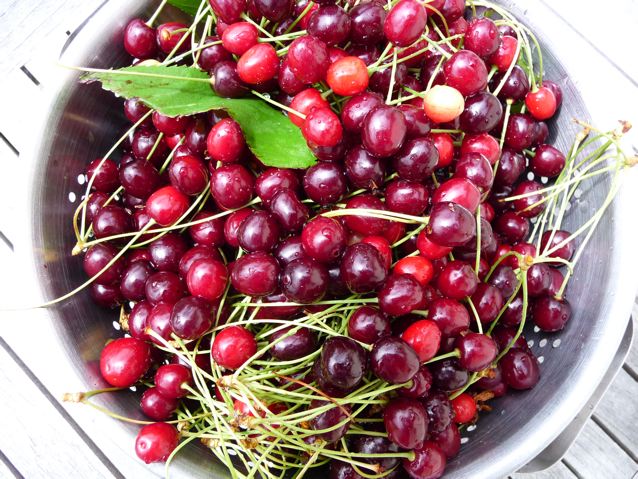
Beauty in a colander
Then consulted Pam Corbin; no cherry jam recipe. Cherries, high in acid and medium pectin it said though. So I de-stoned them, one of those contemplative activities, in which one half of the brain says, ‘I can’t believe you’re doing this’, and the other half says, ‘Yeah, yeah, but once in a while it’s fine to do this and you started this by picking them in the first place so just get on with it. ‘
Then I washed the fruit, put them in a pan to heat up and gently cooked them till the skins had softened. Don’t add sugar till the skins are soft. Added the sugar, heated it till it dissolved, completely, added the juice of a lemon and a little commercial pectin and then brought it to a roiling boil (I love that word!) and it was ready in about 7 minutes. I use a sugar thermometer to monitor the temperature, usual setting point is 104 – 106 C. Test for a set by putting a teaspoon of jam on a cold saucer, turn off the boiling jam while you wait to see if it has set enough. It should wrinkle slightly when you nudge the test spoonful once cooled. If it hasn’t then turn the heat back up again and bring it up to temperature once more.
Tip: the time to stir is when you are slowly dissolving the sugar, once you start boiling the jam, don’t stir as it stops the jam coming up to temperature quickly which is what you want, in order to have a nice fresh tasting jam.
This first batch pictured here was made with 50 percent sugar to fruit weight and was destined to go in the fridge and be eaten quickly. I wanted a tart jam that really tasted of cherries. I made a second lot later with 1 kg of sugar to 750 g fruit that was hopefully to be kept longer. But I was guessing here as to what the correct ratio is. Edit: I have done a little bit more research and the most commonly advised proportions are : 60 per cent sugar to 100 per cent fruit weight. If the cherries are sweet then add a tablespoon of lemon juice for each kilo of fruit. You will probably need to add some pectin, either home made or commercial. Suggested proportions and lots more useful information can be found here where I found it on the Allotment Vegetable Growing site.

Bubble, bubble…
I love cherries and cherry jam is my joint favourite jam along with damsons, and I’m down to my last jar of that, so the cherries should keep me going for now :)

Wild Cherry Jam
And here it is for breakfast on some of that soya linseed bread that makes fabulous toast….an all time favourite Dan Lepard Guardian recipe.

Cherry jam on soya linseed toast