
Robin Redbreast Again

Robin Copyright Zeb Bakes

29th May 2013

The English Robin or Robin Redbreast as she was known when I was a child was probably the first bird I ever learnt to recognise. Small and plump, bright eyed and endlessly curious about the world of humans, the little robin is part of the fabric of the suburban garden life of so many of us in the cities and towns of England. We never get huge gangs of them, as they are very territorial but we nearly always have one or two in residence, checking out what we do, looking in the windows and engaging in our lives.  They squabble and fight, quite badly sometimes and build nests in open fronted boxes and raise their speckly children happily there.

This is the one who you saw sitting on the whirly clothes dryer in the Back Door post. I have stretched my little camera to its macro zoom limits to take these so you can see her more clearly. (If you click on the image I think you might get to see it bigger, I have tried to link to where it is stored on WordPress) .  She sits on the corner of the dryer most mornings, looking down at the grass, and then whizzes down to pick up worms and grubs. Once she has a beakful she heads off over the fence to my left where I suspect she has her nest.

Brian is convinced that she bobs her head at him to tell him the feeder is empty and needs filling and I think he is right, these are the same birds who ask for you to spray the hose for them on hot days so they can take a shower. What adaptive mechanism is at work where a little bird can figure out how to get a human’s attention like that?  Currently we are putting out fat balls, finely chopped peanuts, husked sunflower seeds, and assorted fine seed.

marguerite

The bluetits are nesting and raising their babies, I can hear them cheeping in their box on the garage wall. The blackbirds too are on the hunt for food;  there are jackdaws off to the side in the neighbours’ chimneys. Greenfinches and goldfinches fly through from time to time; they dance in the tops of the silver birches trilling away, offering glimpses of their delicate feathers and making me catch my breath when I track them down.

Even when it has rained all day and the geraniums are collapsed on the path, resembling a  damp poodle’s top knot, sodden with water and formless, I console myself for our everchanging and unpredictable weather, because rain means insects hatching, and worms wriggling; all good quality high protein fresh food for the growing birds.
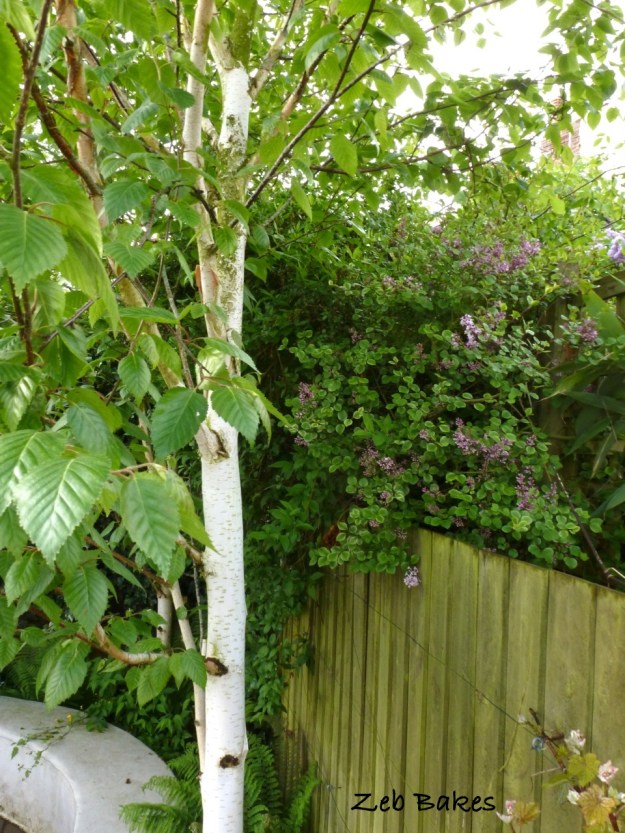
Borrowed Flowers

Psst.. wanna see some American Robin eggs and babies, head over to Ardys and take a peek!

Raisin Goats Milk Kefir Bread (no 3)

Raisin Kefir Bread Cooling Copyright Zeb Bakes

This is the third time I have made bread using kefir inspired by Celi @ thekitchensgarden.com.

My first attempt I made the bread in tinned form and encouraged by the enthusiasm with which they were received I have had a couple more goes.

I have switched to feeding my kefir grains with goats milk as I prefer the smooth results I get with this and I can make a simple cheese with it too.

Room temp 67.6 º F 19.8º C (new thing, I am going to try and always note the temperature of the room if I can when baking) as it makes a huge difference to how fast or slow the processes go.

Kefir Bread Preferment
Stage 1
Make a pre-ferment with
  • 150 g  room temperature water
  • 200 g freshly fermented bubbly kefir (made with semi skimmed St Helens goats’ milk)
  • 150 g very strong flour (Canadian 15% protein from Waitrose)
  • 2 dessertspoons Glastonbury honey

Mix the above ingredients together well till they form a smooth mixture.

Leave in a covered bowl for 15 hours at about 19º C, it will ferment quicker or slower depending on your ambient room temperature.

If you make a note of the temperature and the times each time you bake then you will get an idea of how it works where you live and in your season.

Stage 2
Put the pre-ferment in a bowl
and add
  • 350 g very strong flour (high gluten 15% protein)
  • 350 g Stanway Mill (all purpose culinary white stonemilled flour)
  • 14 g salt
  • 185 g water room temperature
  • 40 g light olive oil or softened butter if you prefer butter
You will also need :
  • A big handful of large raisins or whatever fruit you have available

Mix all the above ingredients (except the raisins) together well to form a dough. I am currently mixing in a stand mixer and it takes about 3-4 minutes to get a good dough which leaves the sides of the bowl by the time it is ready. Be prepared to adjust the water (or, heresy I know add more flour if the dough is not to your liking),

Leave to prove for 2 – 3 hours in a lightly oiled and covered bowl until you can see that there are bubbles forming in the dough and it feels alive under your fingers. It should have risen by maybe a third to a half.

Divide the dough into two parts and make one part as a plain boule and the other as raisin bread.

I used some very large raisins to do this. I wasn’t happy the last time I tried this.  I had added the raisins at the mixing stage and they broke up and smeared inside the dough and I couldn’t control their distribution very well,  so this time I did it differently.

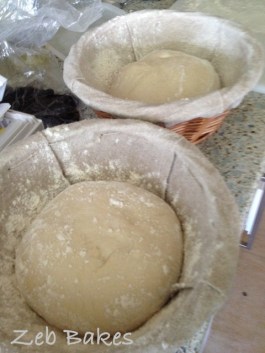
I patted the dough out into a very rough rectangle and placed my raisins over one third of the rectangle. I then folded this over the centre part and placed more raisins on top of the fold and so on, always keeping the raisins inside the dough. I then patted it out again and repeated. I then gently shaped the folded parcel into a boule and tucked it seam side up into a well floured banneton and popped the usual shower caps on top to cover the bannetons.  As you can see in the final photo it came out a little tight at the bottom but none of these huge raisins were on the outside burning and I was pleased with the distribution inside.

Kefir Bread Proving Zeb Bakes CopyrightThe second prove was a leisurely five hours in length and could probably have gone for another hour I suspect.
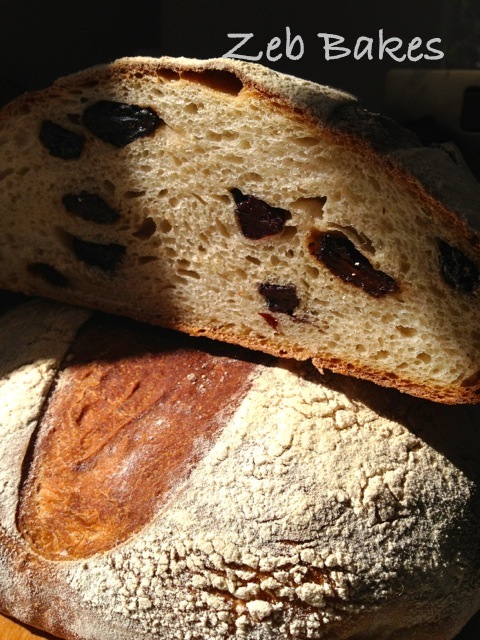
The loaves were baked at 220 C  (conventional electric top bottom heat on a kiln shelf) for the first twenty minutes with steam in a tray and then the oven temperature was lowered to to 200C  for another twenty five minutes. I put the loaves back in the oven once I had turned it off for another ten minutes as they felt a bit soft.

So I reckon you could bake them for at least 50 – 55 minutes if I make them again.

This bread is soft and mild and full of good calcium for old bones like mine and it has been a hit with everyone who has tried it. I have experimented with mixing the kefir with some white sourdough starter and it produced a much more sour flavour to the bread. It still rose but we prefer this mild and delicate taste.

Copyright Zeb Bakes Raisin Goats Milk Kefir Bread

A couple of other lovely bakers making kefir bread with their tweaks and variations are:-

Carl Legge  and ofbreadandquinces both of whom have good experiences with doing this and I suspect there are many other quiet kefir bakers around the world. Real bread – but made a different way from the normal sourdough.

Oh and Zeb likes it too, but he likes most things apart from pickles…

And after all that I completely forgot (birdbrain that I am)  to show you Kefir Levain no 2.

I have the minutest video clip of Brian cutting the finished bread in half on my Flickr Photos

listen to that crunchy honey scented crust!

The view from the Back Door – a challenge

Cecilia @ thekitchensgarden has a wonderful blog with a readership she calls the Fellowship. Her latest post is a beautifully simple challenge and anyone can join in whether or not you have a blog. Read about ‘What I see from my Back Porch’ and maybe have a go.

I just dashed outside and luckily the sun is out and took these two shots to join in:

Looking down the path towards the back and a most attractive shot of the washing line, complete with resident robin,  I am afraid I have edited out the underpants!

From the Back Door - Zeb Bakes

Robin on the line