
Tag Archives: Bread

Beer Bread with Roast Barley Malt

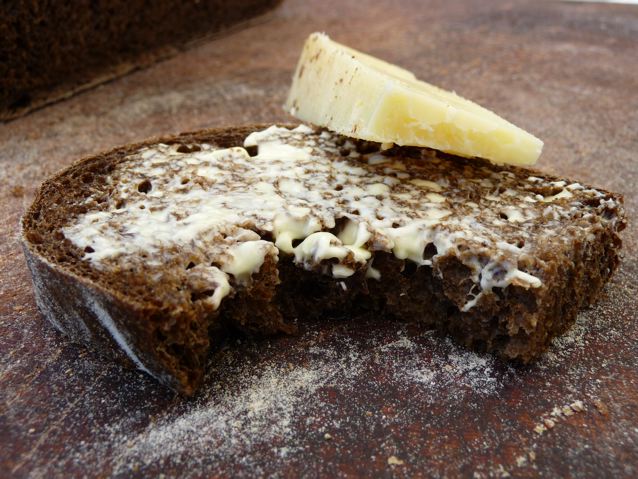
Brian's pic of his fifth slice

It’s almost the end of flaming June and I had one bread left to bake for Mellow Bakers. I’ve been baking lots of sourdoughs and pizza this month,  but there was this one left to have a go at.   Jeffrey Hamelman doesn’t specify the beer, so my fellow bakers have produced very different looking breads, it’s been interesting to see what they have come up with. If you want a peek at what they have been doing in the way of beer breads.  Click here.

So what did I do? I had some roasted barley malt flour from Bakery Bits, so I skipped the part about malting my own barley, which is just as well, as it is really hard to get hold of barley that hasn’t been processed in some way that you can sprout. I can get hold of wheat and rye which are viable, barley for some reason not.

What beer? JH says he used a strong south German beer.  It didn’t give me enough of a clue, so I went with Guinness, it’s dark, sweet and mild and I thought it might be a good one for this bread.
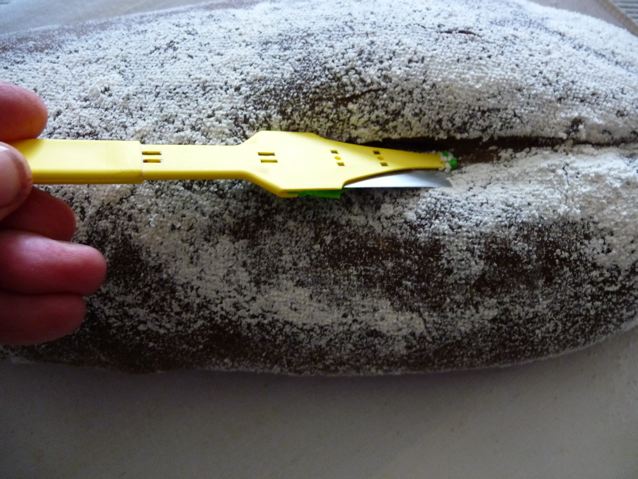
One long straight slash

I’ve never used beer as the straight liquid into a final dough before.  I’ve made barm bread and stout hot cross buns, both Dan Lepard recipes; in those formulae the beer is introduced at an earlier stage in the process, either as part of a sourdough starter or a poolish, and the breads don’t smell of beer once baked which I much prefer.
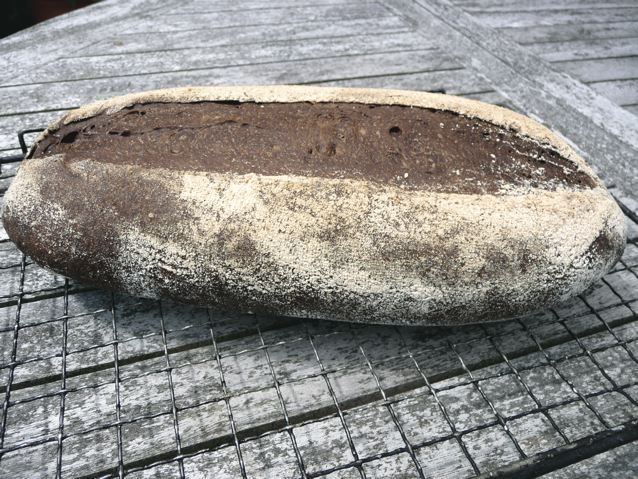
Cooling on the rack

However, Brian said, “Nothing wrong with this bread!” and ate half the loaf.  It looks paradoxically like it should taste really strong and dark, but it didn’t. It was just a crusty yeasted loaf in disguise really. Soft crumb, crusty, mild tasting with a hint of sweetness and malt, no bitterness, but then Guinness isn’t a bitter beer.  I made it as a long oval shape,  proved in a cloth inside a banneton, and that seemed to work out all right. It had a long final prove, about two hours in all.  So a perfectly nice loaf, great colour, split verdict on the smell.

Update: the following day the smell of the bread has changed and, well, I don’t really want to use this word, but…. it has mellowed :) not as beery, more of the aroma of the wheat and wholemeal and roast barley coming through – so if you make it, hold off for at least 12 hours before eating it.
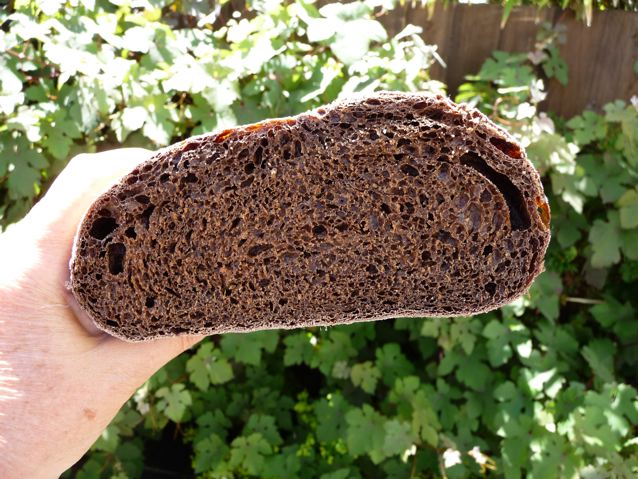
What do you reckon?

Keep the pizza coming….

All stretched out and ready for action

Mushroom and basil and pepperoni

A thin and crispy pizza. Think I am getting the hang of this now. Thanks for the recipe Abby! I like this one. This one was made with dough that had sat in the fridge for 48 hours previously. Baked at a scorching 260 C in my little oven at the weekend.

Edit : Abby says it’s ok to post the recipe so here goes with my version of it: This makes enough for 5 225g pizzas.

680 g strong bread flour (I ran out of strong bread flour so added in some soft plain flour to make up the weight about 200 grams)
12 grams salt
3 grams instant yeast ( I used active instant yeast and I think I should have used a bit less as it’s more potent than regular instant yeast)
Sugar or honey or agave if you like (just a bit)
482 grams water, at room temperature
2 tablespoons olive oil (optional)

Combine all ingredients  at least the night before you want to have pizza. Mix to a rough dough, leave for 20 minutes and then knead lightly either by hand or machine till you get a smooth dough which Abby describes as being somewhere between sticky and tacky.
Put a little oil on a work top. Move the dough onto it. Coat your hands lightly with oil and stretch and fold the dough. Divide the dough into 5  225 gram pieces and round into balls. Figure out how to keep them in the fridge till you need them. I put mine in little plastic pudding bowls with snap on lids, which I had lightly oiled.  Abby used freezer bags which she misted with oil.

I didn’t use the dough for 48 hours, by which time it was pushing the lids of the tubs in the fridge.

I took the dough out about an hour before I used it. It was a very warm day, so you might need to take the dough out earlier if it is cooler.

I shaped the dough into pizzas using a floured worktop, some people do it with oil but I find flour easier, providing you use the minimum you need. I flatten the dough a little with the palm of my hand and then reshape it into a tightish boule. Leave it to rest for 15 minutes or so while I organise the toppings and put the oven on as hot as it gets and put the kiln shelf in ( my equivalent of a bread stone currently).

Then I start stretching the dough. I flatten the boule to a smallish circle and then drape it over my fist and see how far I can stretch it that way before I panic. Forgot to say, I use fine semolina on the peel so that when you shove the peel into the oven, the pizza should slide off as if it’s on ball bearings.  So I carry on stretching the pizza dough out, leaving a lip round the edge. This dough got a bit too thin in the middle, so I sprinkled or shook the tomato sauce over the dough with one of those silicon pastry brushes, rather than drag the brush across the surface and risk ‘holing’ it. Then added toppings, mozarella slices, mushrooms, italian pepperoni,  as above and baked for about 7 minutes.  I added the basil and  a drizzle of olive oil after the pizza came out. Apparently you can freeze the dough too and I will try that and see how it goes.   I met Abby through Mellow Bakers, we are having a great time. If you fancy having a go at French bread or bialys or some heavy duty rye bread that’s what we might be doing this month coming… or not… depends how we feel :)

I’ve got one more pizza crust recipe to try as well that Oggi recommended… that one uses ice cold water.

More Vermont Sourdough..

I blame the starter, it wanted to bake, it was begging me to use it. I hadn’t planned on baking more of the same this week.

I made one of the variations on the Vermont sourdoughs the Mellow Bakers are working on this month;  the one with increased wholegrain. I had some wholemeal flour from Melin Llynnon, a restored Welsh windmill on Angelsey which,  ‘ was known as ‘Môn Mam Cymru’, the ’Mother of Wales’ or ‘The Breadbasket of Wales’  because of its capacity to produce wheat and bread flour in great abundance.’ I also used a little spelt and rye to create a good mix of grain.

One day I would like to tour around all the working mills, large and small that are left in England and Wales.  Anyone like to join me?   Like some people dream about bee keeping, I dream about a mill :)

Quick dough notes:  I used a lot more water than the recipe gives as the flours were very thirsty,  and I  added a small pinch of commercial yeast needing to bake the loaf mid-afternoon.  This gained me about an hour and might have helped aerate the loaf a little more.

A small portion of baker’s yeast, up to 0.2 percent can be added to a levain dough without any noticeable changes in the bread’s sourdough characteristics. This small amount of yeast will have a slight impact on fermentation and dough volume.    Jeffrey Hamelman. Bread P. 152

The bread had a really hot full bake and the crust is a little scorched, but we enjoy a rich dark crust;  Chewy, smoky and nutty with a sweet, well risen middle and an interesting texture from the coarse particles of bran speckling the crumb.   This goes on my bake again list!