Tag Archives: Bread

‘Barleycorn’ bread and pizza light

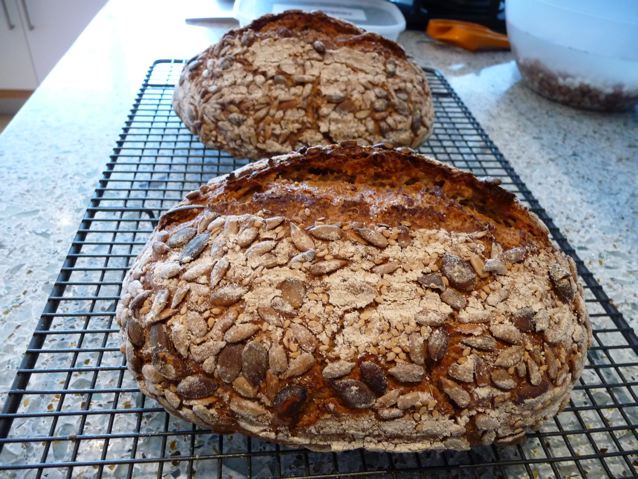
‘Barleycorn bread’

I made a loaf yesterday using Doves barleycorn flour which I had bought out of curiosity.  I would quite like to buy all the bread mixes available on the shelves of my local supermarket and try them just to see what they are like, but I resist usually.

I didn’t use the recipe on the back of the packet but made the loaf using the following:

  • 250g mature white starter
  • 1/4 tsp fresh yeast
  • 500 g barleycorn flour
  • 1 tsp spray malt
  • 275 grams water
  • 1 and a half tsp salt
  • 20 grams melted butter

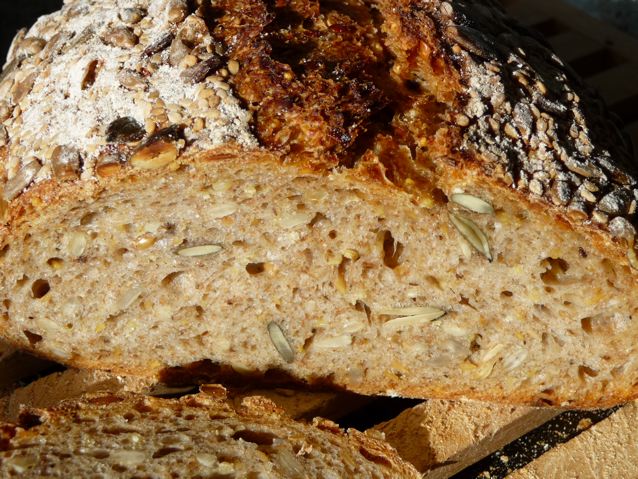
The finished loaf tasted slightly malty and was quite soft, and for my taste a bit boring and bland, I think I will add some whey or yoghurt to it when I use up the other half of the bag and maybe make rolls with it.   I don’t think I would buy it again as I prefer to mix my own flours and seeds.  I also prefer it when the grains and seeds have been soaked before mixing into the dough. Here as the flakes and linseed are already in the flour you don’t have the opportunity to do that and when you slice the bread you can see the little dry bits of cut grain or flakes or whatever it is.
I’ve just been back to read the list of ingredients.

No idea what the last line means. Does it mean there is Ascorbic Acid (Vit C) plus something else?  The mouth feel is definitely soft, like it has a fair bit of malt flour in it.  Reminds me of a shop loaf somehow even with a white leaven starter. Not a bad shop loaf, but still a shop loaf.

Doves Barleycorn Flour

Wheat Flour*, Barley Flakes* (14%), Barley Flour*, Linseeds* (4%), Malt Flour*, Ascorbic Acid + (* Certified Organic, + Permitted Flour Treatment)

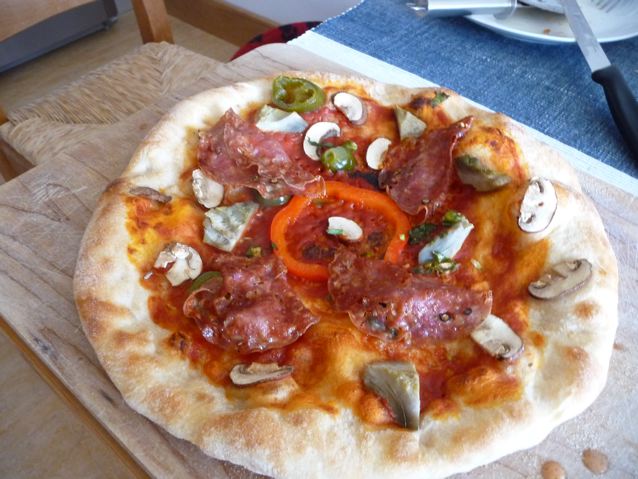
Made up for it with a bubbly long retarded sourdough pizza light on the toppings and cheese which we were very pleased with!

Fresh artichoke, italian fennel salami, jalapenos, mushrooms and a little buffalo mozarella – Pizza light!

In case you are wondering what the pizza is sitting on – it’s a super peel!

Bäcker Süpke’s Wild Garlic Rolls

Wild garlic buns with wholewheat and white flours from a recipe by Bäcker Süpke


Bäcker Süpke is a professional German baker who has a great baking blog where he generously posts recipes. Ulrike, of Ostwestwind, a fantastic home baker, has made them with wild garlic growing in her own garden  – see her beautiful buns here. Lynne, another talented  baker, made this lovely wild garlic loaf from her own recipe!

My contribution has been to have a go at translating the recipe and add a few notes of my own  – I couldn’t resist making a batch as I still have wild garlic in the fridge from my last trip to the woods.

I used a darker flour in the sponge than is intended so my dough was not as soft and flowing as it should be for a more typical ciabatta type roll. If you use white flour throughout you should get a lighter coloured and more airy bun than I did. I used a wholewheat finely milled flour for the sponge, also T550.

My version is as follows:

Make the ‘sponge’ the day before you want to bake. This one has salt in it so I suppose should really be called a paté fermentée but it is not a firm paté fermentée like the one for the rustic bread I made last week.

Sponge
315 g white wheat flour (Type 550 in German)  * But I used this
3 g yeast
2 g salt
263 ml water

Leave at room temperature for 2 hours and then a further 18-20 hours in the fridge.

Final Dough
All of the sponge above 

753g  white wheat flour (Type 550 in German)
5 g malt powder ( optional)
40 ml olive oil
21 g salt (original recipe 32 grams)
20 g  fresh yeast
460 ml  cold water

  • Mix the sponge with all of the water and then add the other ingredients to the dough, mix roughly and then leave for 10 minutes.
  • Oil a worksurface and pat the dough out flat, spread 35 grams of chopped wild garlic over this, and mix it in by kneading, folding etc till it is mixed through the dough and the dough is smooth.
  • Then place the dough in a well oiled container, and fold three times over the space of three hours.  Try not to deflate the dough during the prove. Keep it relatively cool not warmer than 23 ° C.
  • Take the dough out of the container and place it gently on a work surface thickly strewn with flour. Sprinkle more flour over the top of the dough.
  • Cut the dough into irregular shaped pieces of about 120 grams with a dough scraper or sharp knife.
  • Place on baking parchment on trays and allow to settle down and recover from being cut for maybe 15 minutes or so.
  • Handle the dough gently so it doesn’t deflate as you want it to keep the large bubbles.
  • Bake in a preheated oven at 200 ° C Fan/220 ° C conventional oven for 12 minutes, reduce the temperature to 180 ° C Fan /200° C after that. Rotate the trays as needed through the bake.
  • Bake for a total of  20 – 25 min depending on size.

PDF version

Bäcker Süpke says there is some risk that you can confuse wild garlic growing with lily of the valley, which is poisonous, so if you are worried about your identification skills, use chives and a crushed garlic clove instead. I don’t think you can buy dried wild garlic in England.  The leaves and flowers have such a distinctive smell of garlic though that I think it’s hard to mistake!


Using baked bread as a soaker in a mixed rye and grain bread

I got this nice email this morning from Andrew Auld who I know from Dan Lepard‘s bread forum.

Thought of you recently as we had a trip to Copenhagen (Andy’s blog post) and had some great rye bread. Still thinking of trying out a danish rye recipe as our rye breads do sell well. Will have to try the soaker recipe you referred to .. .

do you have a link?

I hope this is the one you are thinking of…

This bread requires both a cold soaker and a sourdough leaven

Cold Soaker

  • 50g baked rye bread (or ryvita if you have no old bread- by old bread I mean bread that is maybe 3 days old, hard but not mouldy of course, rye breads tend to age very gracefully and you can always put the end of a good loaf in the freezer with this bread in mind)
  • 25 g linseed
  • 25g millet
  • 20 g malted rye grains  or any cracked smallish grain you have that you like
 – these are small pieces of rye that have been malted by the mill (in this case Shipton Mill in England)
  • 165g water

Extra thoughts eighteen months on….To make the cold soaker, slice the bread thinly and cut into small fragments and put together with the seeds in a bowl, cover with the water and leave for 12-16 hours. If it feels very lumpy then I recommend whizzing the mixture with one of those handheld whizzy things or in a food processor to break up the lumps of bread.  If you are someone with many bowls, you could make two cold soakers, one with the bread and one with the seeds, and distribute the water between them. If you bake the slices of bread till they are golden brown before soaking, you will increase the umami flavour of your final bread.

Starter

  • 30g mature rye leaven
  • 200g lukewarm or room temperature water
  • 225 g dark rye flour (whole rye flour)

Make both the above at the same time,  12 hours plus before you want to mix the dough

For the dough

Mix both the above together. I use an electric hand mixer to do this.

Then add:

  • 370 g strong white flour
  • 105 g water
  • 15 – 20 g salt
  • 150g worth of toasted pumpkin and sunflower seeds
  • 1/4 teaspoon of easy bake yeast (optional)

Makes a quite sticky dough. Leave for 10 to 20 minutes. Do a quick knead and then leave it alone. It becomes less sticky after a while.

If you use the yeast, bulk ferment for about an hour and then scale and shape and leave to prove again for another 1 – 2 hours depending on dough temperature, room temperature etc. If you don’t use the yeast, then it will take longer of course.

I put seeds in the bottom of the banneton but you can mist the top of the dough and sprinkle seeds on top just before baking.

Slash the loaf well!

Oven temp 230 º C  for 10 minutes with steam in the oven (little tray in bottom with boiling water in)  turned down to 220 º C once the loaf has sprung and started to go brown for 20 minutes and then 210 º C  for the last 15 – 20 minutes.

Looks like Andrew liked it :) See pingback below! And this is his emailed comment:

…Definitely a deliciousness to the rye bread which I think is down to the umami effect of the old bread you mention on your blog.

Used some of the 100% rye loaf we do inspired by your recipe on dan’s blog. It has pumpkin seed and orange in it. Will be making it again for sure.

And here is Andrew’s bread ready for sale!   here