
Cheddar cheese, baby spinach leaves, tomato and balsamic apple chutney on Rustic Bread
This bread is made with a paté fermentée, or old dough: a firm mixture of flour, water, a very small amount of yeast and salt prepared anything up to 24 hours before you mix the final dough. Why do bakers do this?
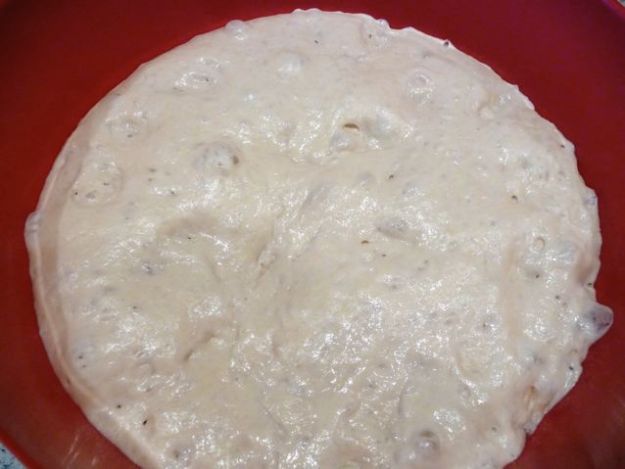
The conventional wisdom is that you are prefermenting some of the flour in the bread – in this recipe that’s half of the total flour in the final bread, and therefore the final bread will be more digestible, flavoursome and will keep better. It is also a way of keeping the yeast alive and storing it from one bake to the next in the absence of refrigeration.
The next day, following the recipe, I mixed the remaining flours, white, wholemeal and rye with water, more salt, a touch more yeast, then cut up the paté fermentée into chunks and….

…went to work. Mixing an all white firm dough into a new lot of mixed flour dough was a challenge. My hand dough whisk wasn’t up to the task so it was a case of taking a good stance and kneading hard for once! I worked away on this dough for a good 22 minutes in an attempt to blend the all white paté fermentée into the mixed flour dough. Once I settled down to slapping the dough around to integrate the two parts I was happy but I hadn’t anticipated how hard it would be, and it threw the timings out. No nice and easy light kneads for this bread! Another time I think I might mix the paté fermentée with half of all the flours, so that at least it would be the same proportions of flours in each of the two doughs. Or go and buy a mixer…. expensive though aren’t they?
I used two sorts of Waitrose flour: look where it comes from!

and the stoneground wholemeal bread flour, from Canada too. The very strong white flour was mixed with some of Shipton Mill’s bakers finest white which is not as high in protein but has many good qualities and I had some organic dark rye from the Mill as well.

What else was a bit different?
I added some whey from my last batch of yoghurt in the final dough but only a small potful, about half the final water weight. I think it adds to the umami flavours of the crust and I have a feeling it speeds up the fermentation – the dough was very lively all the way through, producing huge gas bubbles and I needed to control them with several long big folds as I don’t do punching down.
I made a round boule and an oval loaf, and used a couple of forms dusted with rye flour to hold them while they proved. They were hopping out of these after an hour and 15 minutes. I hoped that they would both fit on the stone, but I realised when I ‘outed’ the first one that I was going to have to do a bit of juggling as they wouldn’t fit. So I started one on the stone, moved it up to the little top oven after 20 minutes, and then put the next one in down below. It all worked out ok in the end.
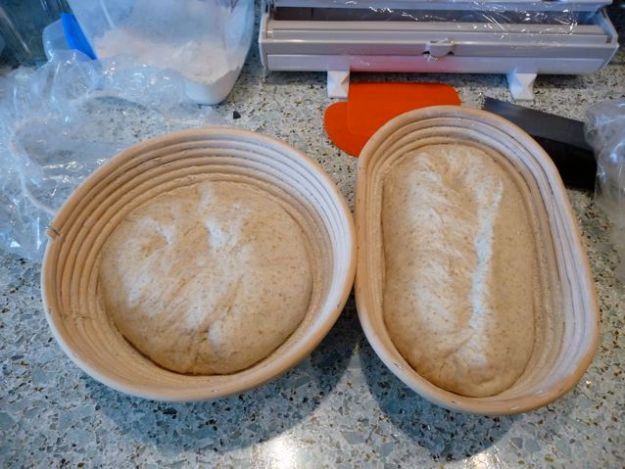
Here they are just starting their final prove
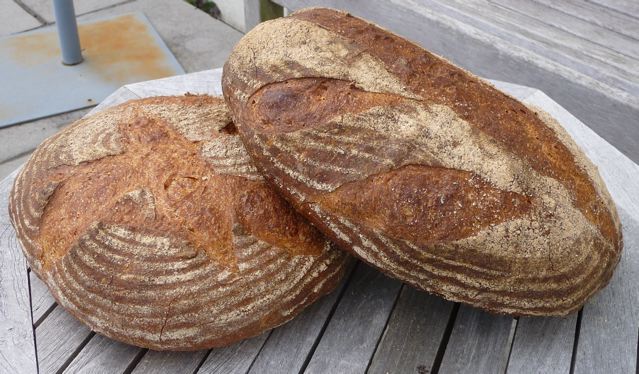
Like Abby says it wasn’t that easy to slash and I attempted an over ambitious pattern on the round one which went a bit awry.
 Cooling down in the garden
English people tend to prefer paler crusts, but I am a big fan of the taste of these dark crusts and the contrast with the airy, creamy crumb flecked with the bran from the stoneground wholemeal flour. Good crust and a light crumb that didn’t squash together when you sliced it. Great aroma too – I wish WordPress did ‘scratch and sniff’ but maybe one day….
The CBT said it was ‘yummy’ and promptly ate 4 slices so I don’t think it is going to hang around for long. He says it is one to make again and I think he is right :)
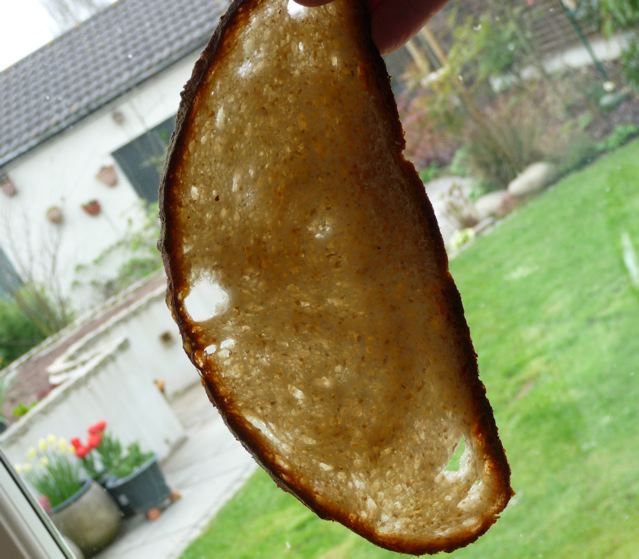
I did my own windowpane test to see what the slice looked like. You can see the way that the two doughs didn’t mix perfectly, and that there was the odd huge bubble that got through to the final bread.

 Rustic Bread by Zeb Bakes
The recipe for this Rustic Bread can be found in Bread by Jeffrey Hamelman.
3 down…..and a few more to go! I’m enjoying this!




 Strong while they are raw, the taste is very mild when they are cooked. Pick the small leaves and the flower buds and keep them in a cardboard punnet in the fridge, sprinkled with a bit of water. They should keep a day that way. If you can’t bend down to grab some, then Riverford Organic Vegetable boxes have them too in the next week or so. I bet there are loads of recipes around.



 Zeb Bakes