Category Archives: Bread

Raisin Goats Milk Kefir Bread (no 3)

Raisin Kefir Bread Cooling Copyright Zeb Bakes

This is the third time I have made bread using kefir inspired by Celi @ thekitchensgarden.com.

My first attempt I made the bread in tinned form and encouraged by the enthusiasm with which they were received I have had a couple more goes.

I have switched to feeding my kefir grains with goats milk as I prefer the smooth results I get with this and I can make a simple cheese with it too.

Room temp 67.6 º F 19.8º C (new thing, I am going to try and always note the temperature of the room if I can when baking) as it makes a huge difference to how fast or slow the processes go.

Kefir Bread Preferment
Stage 1
Make a pre-ferment with
  • 150 g  room temperature water
  • 200 g freshly fermented bubbly kefir (made with semi skimmed St Helens goats’ milk)
  • 150 g very strong flour (Canadian 15% protein from Waitrose)
  • 2 dessertspoons Glastonbury honey

Mix the above ingredients together well till they form a smooth mixture.

Leave in a covered bowl for 15 hours at about 19º C, it will ferment quicker or slower depending on your ambient room temperature.

If you make a note of the temperature and the times each time you bake then you will get an idea of how it works where you live and in your season.

Stage 2
Put the pre-ferment in a bowl
and add
  • 350 g very strong flour (high gluten 15% protein)
  • 350 g Stanway Mill (all purpose culinary white stonemilled flour)
  • 14 g salt
  • 185 g water room temperature
  • 40 g light olive oil or softened butter if you prefer butter
You will also need :
  • A big handful of large raisins or whatever fruit you have available

Mix all the above ingredients (except the raisins) together well to form a dough. I am currently mixing in a stand mixer and it takes about 3-4 minutes to get a good dough which leaves the sides of the bowl by the time it is ready. Be prepared to adjust the water (or, heresy I know add more flour if the dough is not to your liking),

Leave to prove for 2 – 3 hours in a lightly oiled and covered bowl until you can see that there are bubbles forming in the dough and it feels alive under your fingers. It should have risen by maybe a third to a half.

Divide the dough into two parts and make one part as a plain boule and the other as raisin bread.

I used some very large raisins to do this. I wasn’t happy the last time I tried this.  I had added the raisins at the mixing stage and they broke up and smeared inside the dough and I couldn’t control their distribution very well,  so this time I did it differently.

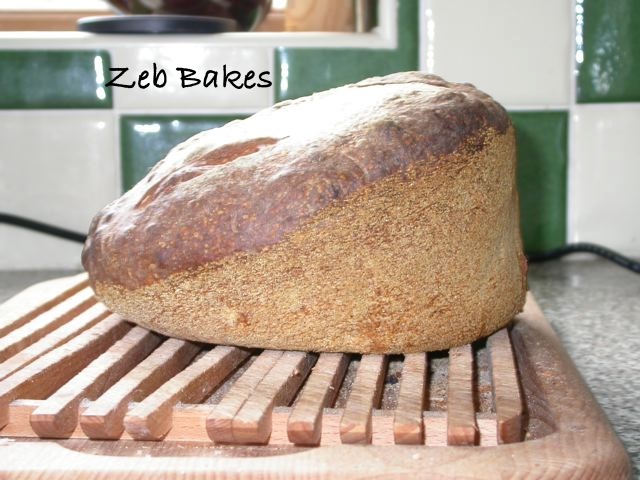
I patted the dough out into a very rough rectangle and placed my raisins over one third of the rectangle. I then folded this over the centre part and placed more raisins on top of the fold and so on, always keeping the raisins inside the dough. I then patted it out again and repeated. I then gently shaped the folded parcel into a boule and tucked it seam side up into a well floured banneton and popped the usual shower caps on top to cover the bannetons.  As you can see in the final photo it came out a little tight at the bottom but none of these huge raisins were on the outside burning and I was pleased with the distribution inside.
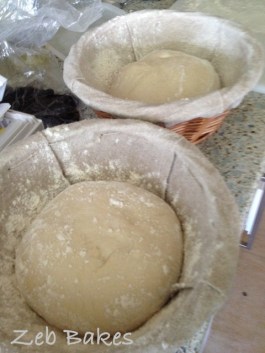
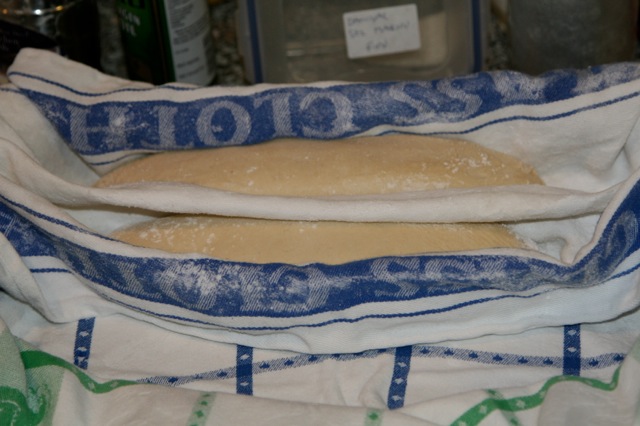
Kefir Bread Proving Zeb Bakes CopyrightThe second prove was a leisurely five hours in length and could probably have gone for another hour I suspect.

The loaves were baked at 220 C  (conventional electric top bottom heat on a kiln shelf) for the first twenty minutes with steam in a tray and then the oven temperature was lowered to to 200C  for another twenty five minutes. I put the loaves back in the oven once I had turned it off for another ten minutes as they felt a bit soft.

So I reckon you could bake them for at least 50 – 55 minutes if I make them again.

This bread is soft and mild and full of good calcium for old bones like mine and it has been a hit with everyone who has tried it. I have experimented with mixing the kefir with some white sourdough starter and it produced a much more sour flavour to the bread. It still rose but we prefer this mild and delicate taste.
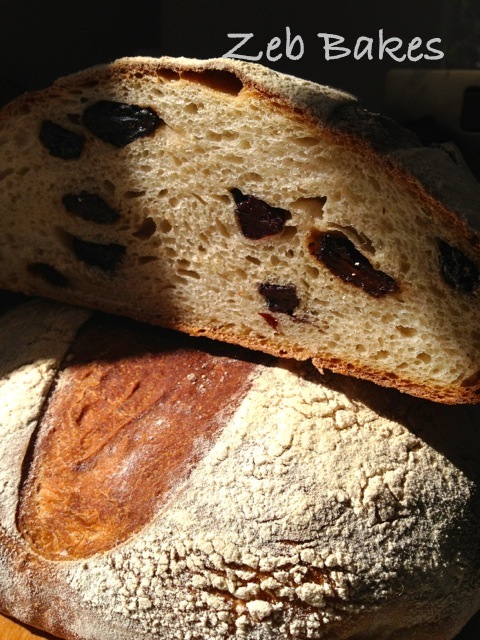
Copyright Zeb Bakes Raisin Goats Milk Kefir Bread

A couple of other lovely bakers making kefir bread with their tweaks and variations are:-

Carl Legge  and ofbreadandquinces both of whom have good experiences with doing this and I suspect there are many other quiet kefir bakers around the world. Real bread – but made a different way from the normal sourdough.

Oh and Zeb likes it too, but he likes most things apart from pickles…

And after all that I completely forgot (birdbrain that I am)  to show you Kefir Levain no 2.

I have the minutest video clip of Brian cutting the finished bread in half on my Flickr Photos

listen to that crunchy honey scented crust!
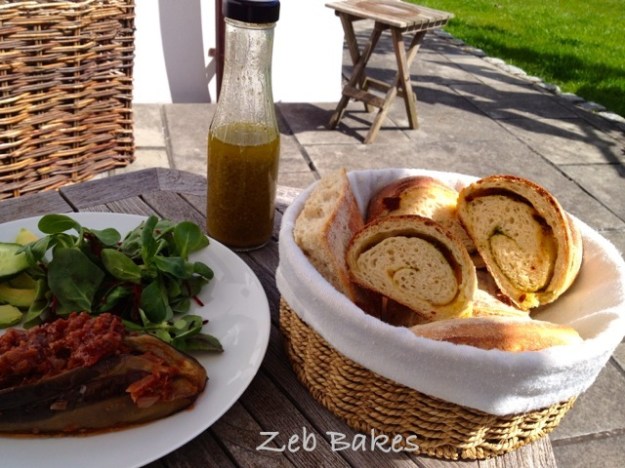
Semolina Bun Bread with Wild Garlic and Sundried Tomatoes

IMG_1460

23rd April 2013

The Dan Lepard fan club knows that in his repertoire of awesome buns are some absolute treasures to which one returns time and time again. My favourite three are the legendary soft white bap, the top teacake and our eternal favourite, the BBQ semolina bun. Known in this house variously as the duvet bread or the pillow bread because of the scoring to the top, I make this bread over and over again. The recipe for the Semolina BBQ buns is still available on the Guardian website and I don’t change anything at all when I make it.

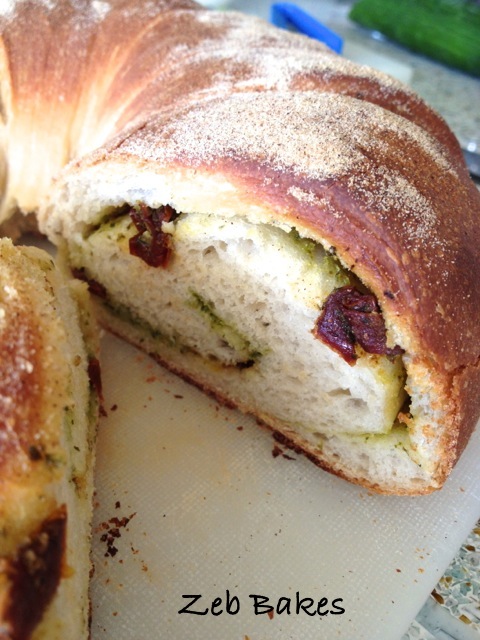
Today I made a double batch and made a duvet with one portion. With the second batch of dough I thought I would try something a bit different for me. When the dough had finished its first prove, I patted and gently rolled it out into a largish rectangle and spread it lightly with some wild garlic, grated pecorino cheese, ground almonds and olive oil made into a pesto-like sauce and a few sundried tomatoes. I rolled it up gently into a sausage shape and curved it into a ring. I set it on a sheet of baking parchment on a tray and put it inside a clean bin bag to prove. Before baking, I slashed small slashes in the top and brushed it with water and sprinkled fine semolina over it.

I baked it at 240º C (220º C Fan) for 15 minutes and then reduced the temperature to 200º C (180º C Fan) for another 15 minutes and then took it out of the oven and left it to cool and stop sizzling on a rack. The bottom was very crusty. If you don’t like crusty then bake it a bit cooler.

The trick with doing this is not to squash all the air out of the dough when patting it out to the rectangle, use the flat of your fingers to start the process off. When you use the pin, roll as gently as you can from the centre of the dough towards the corners to get a rectangular shape, and take your time. If the dough is pinging back a lot, walk away for five minutes and let it relax before you try again; try not to compress the dough too much, you are sort of stretching and fluffing it, rather than rolling and squashing. I am thinking about the way I pat out pizza dough rather than use a pin, though that is of course a different dough and more delicate than this.

IMG_1463_2

My dearest old neighbour from where I used to live came round for lunch and we ate in the garden, yes really it was warm enough to eat outside!! We were accompanied by the sound of building work from two doors down, visits from some very large bumble bees, and the grumbles of small poodles, but you know what, it was glorious!

IMG_1457

Brian had bought an entire box of aubergines for the sum of £2.75 at the weekend and even though he gave two-thirds of them away we still had lots left to cook, so it was more swooning and more olive oil and more Imam Bayildi for lunch today. I changed the spices slightly this time and left the onions chunkier, using allspice and a very new hot smoked paprika. We are still swooning… and I promise not to mention it again, but it is really very good indeed.

Singing Crusts and Rising Bread

Zeb Bakes Apple Bread

This is going to be what I now believe is called a ‘longform’ post. i.e. more than three lines and two photos.

It has been about five years now since I picked up a bag of flour and wandered dustily down the bread road.

Other people in the same time span have started their own businesses, gone to baking school, and done all sorts of wonderful things seduced and entranced as they are by the whole baking world.  I still haven’t made croissants or doughnuts, but I like to think I can make a reasonable loaf of sourdough and great pitta bread.

In this post I just wanted to have a little chat and a meander through my baking past such as it is,  because I sometimes think that people don’t quite believe that we all go down the same road more or less trying to figure out this bread thing, which is how to make bread that makes us and the people we share it with happy!

I have spent a bit of time trawling through old photos, many of which were taken by Brian, (the clue is that his have that fancy blurred background thing going on).  I will try and do a ‘with hindsight’ running commentary on what was going on, and what might have gone wrong, but it is hard to know exactly. If you knew me when I posted on Dan’s forum you will have seen these photos before as I puzzled over what to do to put things right the next time…

First Mill Loaves!

Here we have two of my very earliest loaves, I was very ashamed of them, but I also thought they were quite funny so I took their photo vowing that I would do better next time.

They were both made from the same dough, the flatter of the two on the right had stood for about an hour longer than the other one before being baked and was completely and utterly overproved. The very dark one had been in the oven for ages at a very hot temperature. All those hours of waiting and I wasn’t very impressed.

However my best loaf possibly ever and the one that makes me smile the most is this one:

Mouse Cathedral 1

This was an experiment in not kneading and not folding and putting dough in the fridge overnight. I thought I would be even more minimal than the most minimal of bakers and very clever. I hadn’t really understood that you have to get rid of some of the bubbles in the dough, or stretch and shape it.

Mouse Cathedral 2

As you can see it turned into a mouse cathedral, and rose in a way I have never been able to replicate since. I think there was so much air in the dough that it just didn’t know what to do. Ah me.

White LevainThis was my first attempt at a basic white sourdough made with Dan Lepard’s recipe in the Handmade Loaf. It is a simple dough but not an easy one to handle if you are starting out. I read somewhere the other day that simple is not the same as easy, and this certainly applies to bread making. I think I had used so much oil to handle the dough that the crumb took on a shine resembling my face after a day in the kitchen. Using oil to shape dough is very useful, but too much can cause problems, particularly when it comes to sealing the seams underneath with a firm dough. Use it sparingly and save yourself this grief.

At this point I spent a lot of time reading about flour and reading bread books and decided that if only I had the ‘right’ flour I would make much better bread. In fact I hummed and hawed about this a lot, bought all sorts of different flours and experimented madly, and spread myself so thinly that I never really knew what I was doing.

Sourdough overnight baguettes - 9

I made an attempt at  overnight sourdough baguettes and was appallingly pleased with myself. In fact it is just sourdough in baguette shape but no matter. As I have said before I am not a perfectionist and am easily pleased! Look at their funny little shapes and their slashes!

IMG_2989

I proved these in my old cotton teatowels, no fancy couche cloth here, not a clue really what I was doing, but I do remember eating these, baked from cold from the fridge and being extremely happy and greedy.

How many can I eat?

I carried on making breads and posting about them on Dan Lepard’s forum, I shyly chatted away to people who also posted. I made friends, I asked questions, I began to think I knew some of the answers and tried to help people who also turned up, the curse of being an ex teacher and wanting to share knowledge, partial though it was and still is.

It was a lovely forum, with a great mix of people from experts to beginners and was very gentle and friendly. I admit I bought brotforms, in those days not as easy to find as they are now,  so I ordered some from Germany. I found two french banettons with linen liners in a catering suppliers in the UK too.  My early banetton loaves had a ghostly white pallor as I had read somewhere to dust them with potato flour to stop the dough sticking. It works fine but doesn’t change colour in the oven at all. The loaves were beginning to look like loaves that made sense to me at last.

Mill Loaves again

I am not the most consistent of people and I maybe never took the baking or the blogging quite seriously enough to be a bona fide food blogger nor a baker but every so often I get a nice comment or an email from someone who has been brave enough to make something based on what I have written here and then I feel very pleased that I have helped which brings me to the highlight of my blogging week:-

Highlight of the week

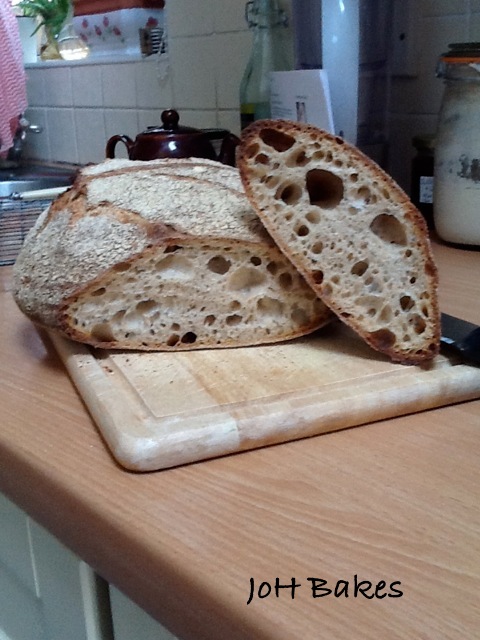
JoH Bakes Beautiful Sourdough

Look at that crumb!

Look at that crumb!

Sharing and Baking

These are photos of JoH’s sourdough that she sent me this week which I am allowed to show you.  I think her bread looks just great and I am delighted that she too is jumping up and down with happiness at making a loaf that pleases her. She was working from my weekly sourdough sheets which you can find here → Weekly sourdough pdf

So here’s to all of you brave and foolhardy people who drag a bag of dry flour into the kitchen, squint at a recipe, wonder over instructions like ‘give the dough a turn’ or ‘ form a boule’, who convert cups to grams and ounces to handfuls,  burn your arms and skid on semolina, to those of you who sit by your ovens and smile as the bread rises,  feed your friends and family, share pictures and stories, advice and lore on the internet, with your salt and your leaven, your ferments and baskets, I salute you, may your bread rise and your crusts sing and crackle!

Oh and a last word of my best well-meaning advice – don’t worry about what they do on TV, follow your instincts, take it all with a pinch of salt, they don’t know it all, no one does – question everything, practise lots, study your failures, as they will tell you more than you think, and have a good time!