
Category Archives: Mellow Bakers

Horst Bandel Crumb rye bread

Hamelman’s Horst Bandel Rye Bread in a Milk Loaf Tin

Horst Bandel black rye pumpernickel Jeffrey Hamelman

Photo by Brian

It’s that bread again!  (the long slow baked rye grain bread with the great back story in Bread by Jeffrey Hamelman) which is one of the Mellow Bakers November breads.

I posted my last year’s version of this a little while ago but I have made it again – practice, munch, practice. It’s fun!

A little Swedish Kaviar

I had a long think about how you could manage this bread without a pullman. I think the answer, (and I will make it a third time to test it out by the end of the month I hope)  is to use a regular loaf pan and once the dough is in the tin, grease and flour a sheet of foil, and  place it over the top of the tin and either wrap the whole tin in foil tightly or tie it on with string round the rim of the tin. Alternatively if you don’t mind what shape your bread comes out, use any bake proof container that has a sealable lid, so a pudding basin or a cast iron pot or something like that.

Mise en place

The key thing is to keep the moisture in during the long gentle bake.

My other tips are

Rye grain

Raw and Cooked Rye Grain

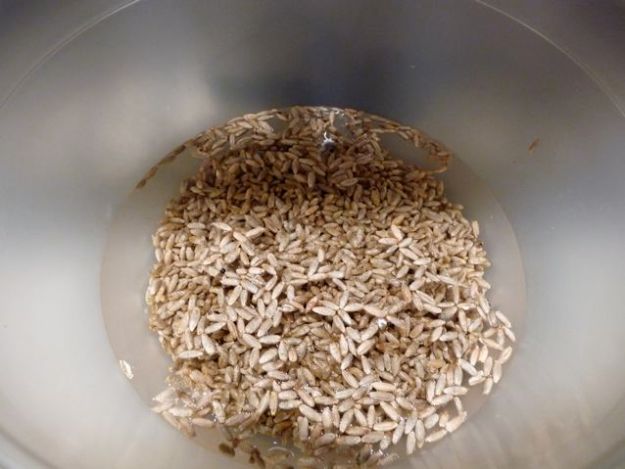
  1. Make sure the grains (use wheat if you can’t get hold of rye) are well soaked and really well cooked so they are plump and moist and soft. They act as storage for the water during the bake.
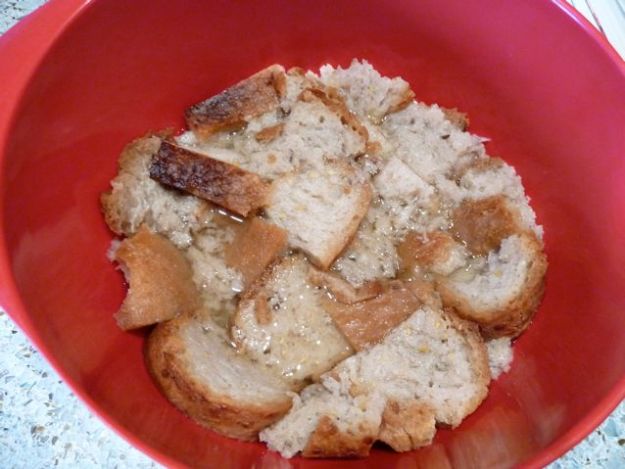
  2. Old Bread Soaker

    Slice the old bread thinly and bake it a bit more in the oven before you soak it. Only use as much water as you need to cover it; you are only going to have to squeeze the water out later after all.

  3. The hardest bit is judging how wet to make the dough, too wet and the bread will never really dry out enough, too dry and it will be a bit chewier than you want.  That’s not very helpful but everyone’s combination of grains and breads is going to vary. I think I would want to go for a dough that I can shape into a baton that I can pick up without it breaking apart the moment I lift it from the bench, so go for firmer rather than wetter.

Another experiment revealed!

I have a milk loaf tin which has a clip on lid so I thought I would try it out in that. In my mind the bread would rise, slowly into the top half and I would have incredibly sophisticated round slices of bread, perfect for canapes.  The drawback, pretty major, of these tins is that you can’t open them to check on progress. There is a tiny peep hole in the top of the tin – once the dough is at the top you can see it. This dough didn’t get that far. I stuck a toothpick in the hole every so often to see if I could judge where it had got to, but it never got right to the top. In fact I overproved this one by about 6 hours (!) and you can see the results here. I don’t think it made any difference to the bread though, in fact it might have improved the flavour a bit.

What do you reckon to this one?

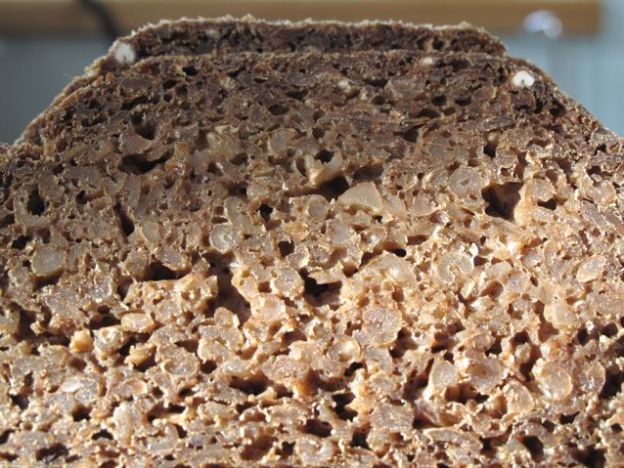
So I ended up with a half round loaf. This time it was completely cooked through and very even in texture. Still not as dark as I would like it to be to justify being called ‘black rye’.  I like the taste, much milder than I thought it was going to be; sweet and nutty and very fragrant.
Horst Bandel rye bread

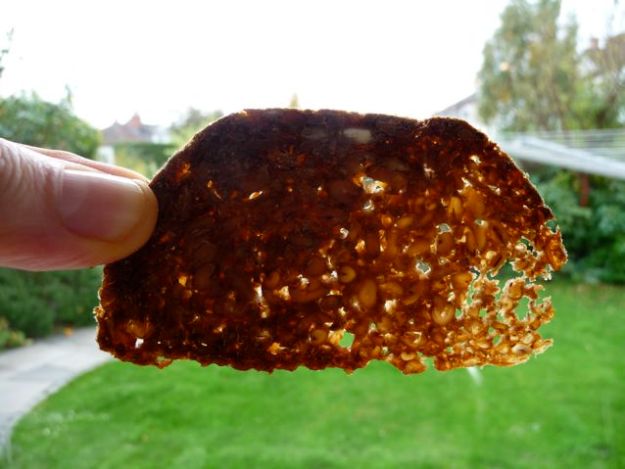
Zeb's windowpane test!

Horst Bandel’s Black Rye ‘Pumpernickel’

Horst Bandel Jeffrey HamelmanThis is one of the November breads that the Mellow Bakers are baking this month.

I baked this for the first time last year and these photos are from that bake. I am sure I can do better, but I don’t know if I will get round to it this month again so I thought you might like to see this early attempt.

If you remember the post about obscure objects of desire, then the experience of baking this bread definitely fits into that category. Why? Borrow the book and read the story about this bread and you will want to make it or maybe just dream about making it.  I fell in love with the whole magic of bread baking when I read this the first time,   I simply wanted to be there and watch the process, to see and smell the breads coming out of the oven, understand the way it was done and then try for myself.

Technically, this is not a pumpernickel as Germans know it, because it doesn’t have enough rye in it. German bread regulations are very clear on the subject.  Here in England and I guess on the other side of the Atlantic too, the rules about what you can name a bread are ‘fluffy’. The subject of another post maybe?

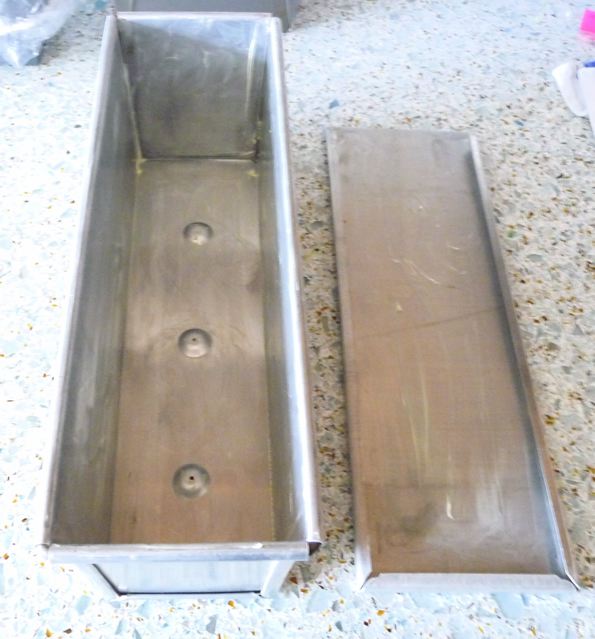
The Horst Bandel black rye bread and other similar breads are often baked in a pullman tin. One of the mysteries of the baking business in England is that loads of breads are baked in neat long flat topped shapes, you see them everywhere bagged up on the supermarket shelves, but for a home baker to get hold of one of these tins with its sliding top is not such an easy task.
pullman tin

In the end I bought the one on the left on Ebay – it came from Malaysia. And then this year I was brought one from France by lovely Mike, courtesy of Yolande.  They are expensive bits of kit for the very good quality ones,   so unless you are sure you really want to make lots of square flat topped breads, I wouldn’t put this tin at the top of your ‘must have’ list.  You could always put a baking sheet on top of an ordinary bread tin and weight it down in the oven with a casserole or something like that.

The formula asks for ‘rye chops’ and ‘rye meal’ . These are different cuts and grinds of rye. English supermarkets usually stock one variety of rye flour if you are lucky. No choice at all as to grind, you can’t usually even get light and dark rye.  My friend Mandy came to the rescue and brought me lots of bags of rye from Germany in different grinds, though we were both guessing what was required. Nils at Ye Olde Breade Blogge advised me too and took a picture to show me what coarse rye meal looks like in his Saftig Kerniges Roggenbrot post. Nils is brilliant on rye breads!

So rye meal, is very coarse ground rye, but it is ground. Rye chops, as I understand it, is the whole rye grain (or berry as some people call it) cut into three or four pieces, so the inside of the grain is exposed and can therefore take up moisture more easily I suspect.

Shipton Mill at one time had chopped rye for pumpernickel, but the last two times I have asked they didn’t have any. I think the answer is not to get to hung up on all this but to try and source some whole rye grain and some good fresh rye flour and just have a go if you want to try this one.

Old Bread SoakerThe formula also calls for one of my favourite ingredients ‘an old bread soaker’. Ugh, I hear, you say,  putting stale bread in a new bread, what is that about?  Trust me, it works, it’s delicious.
I posted one of my favourite bread recipes here which uses an old bread soaker if you want to try an easier bread than this one to see how it goes. Obviously don’t use mouldy bread, just next time you have a good sourdough going and you have got to the end of the loaf, put the end in the freezer, chopped up and then when you want to make a bread calling for an old bread soaker you will have it to hand. It adds buckets of flavour and is quite common in Germany, where once again there are rules about how much old bread can be added to a new dough.

I reckon I did OK on the mixing and the soaking and the cooking of the grains and so on. I came a little unstuck on the cooking of this bread. My oven couldn’t go cool enough I think. The bread when I finally took it out, was a little hard on the outside. I wrapped it up and left it for two days before cutting it, and the crust had softened a bit by then. It had the right taste, fragrant and sweet and dark and very substantial.
A bread to be sliced thinly and smeared with unsalted butter and topped with strongly flavoured sausage or herring, a little sourcream….a slice of egg, a sliver of radish….

I’m really looking forward to seeing what the others Mellow Bakers do with this recipe!

Edit: Ulrike, a very knowledgeable German baker, has made this bread today and from what she explains here I think one of the reasons that my bread went hard on the sides is because the pullman has holes in the bottom and allowed the steam to escape from the tin. So what is needed is a tin which has a much better seal than that ebay one. I am thinking of trying with my milk loaf tin. That is a lot smaller and has a clip that allows you to seal the bread tightly. And then I would have elegant round slices of pumpernickel….

Another Edit:  I have a poor memory!  I now remember this thread on the Fresh Loaf worth looking through before you start.  I not only read the early part of it,  I even commented about  maybe using a fish kettle to cook it in.  It looks like the discussion on how to bake this bread got quite intense later on.  This is a bread that arouses strong passions and feelings !


Challah for Mellow Bakers

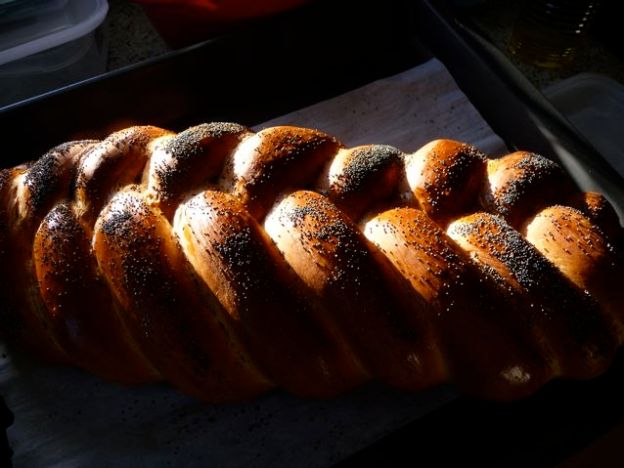
Journeying through the wonderful collections of breads in Bread by Jeffrey Hamelman, from time to time I come across a bread that simply doesn’t resemble the bread I associate the name with. This challah is a prime example of this. Challah in my childhood was a soft, dense white bread, plaited tightly and tasting of poppy seeds. Whether England was still in the post-war egg rationed mode in the early 1960s, I don’t know. Today’s American challah bread I can only describe as a butterless brioche, light as an angel’s feathers and almost ethereal. I doubt my grandparents would recognise it.

I have put off making this bread. Everytime I looked at the recipe, I thought, hmm, I don’t have enough eggs, or I’m going to have to think very hard about braiding and so it has gone on till this morning, when there were indeed enough eggs and I had thought long enough about braiding.  It’s a bit like when you are learning to drive and it just seems impossible that anyone will ever give you a licence. You just have to look around you and say, “Hey, all those people can do it, it might be difficult, but it can’t be impossible.”

Celia has created a beautiful tutorial showing how to braid a Winston Knot. How could I fail with that guide?   I printed it off and kept it close by while I made the first braid. I almost panicked when at the bottom of page 1, I could only find page 3 –  I squawked and then found page 2 which had got stuck to the back of page 1. Disaster averted but it was close.

So here are the pictures of my challah adventures for Mellow Bakers this morning, not quite as hard as it looks but still required some serious concentration.

This slideshow requires JavaScript.

Notes:

I mixed the dough in a Kenwood mixer. I put the eggs, water and oil in first, added the salt and sugar to that. I added the yeast to the two flours separately and then added the dry to the wet, that’s the way the Kenwood likes it.  I also hand kneaded the dough for about 3 minutes once the Kenwood started rocking about. The dough was left in the fridge for a couple of hours, but there is so much yeast in it that it still had to be knocked down every 40 minutes or so. I am sure one could make this with less yeast!

I made the braids for the Knot 150 grams each and rolled them out to 60 cms long having been forewarned.  This left me with 800 grams of dough for the 6 strand plait so they were smaller at  133 grams each.  Even so both loaves were huge by the time they had proved and baked. I showed them off to my neighbour and then gave her the Winston Knot to take home. Too much bread for us and no room in the freezer for such a monster.

The other bread which was a 6 braided loaf was easy by comparison.

So don’t be afraid, well don’t be too afraid, if a braid-phobic like me can do this, you can too !  This was one of the October breads for Mellow Bakers. Thank you to all those of you who have already baked this, by watching and learning from you all I have gained so much.