Category Archives: Recipes

A bowl of good old butterbeans – tra la!

I know you expect bread –  but I am also a big fan of vegetables and beans and pulses 

Warm butterbean gremolata
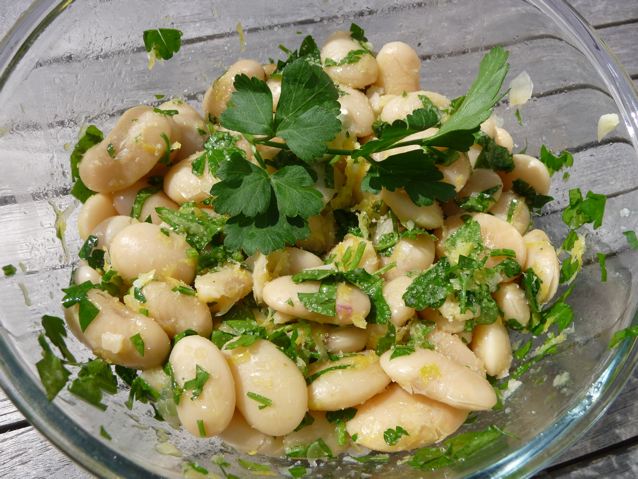

I think everyone has their favourite beans. What are yours?

I never ate any of these dried wonders until I left home. They weren’t in my family’s food vocabulary.  Like a lot of the foods I am interested in, they require work to transform them into something that you really want to eat.

I don’t think they are as popular as the baked bean in the heart and tummy of the English so I am putting a word in for them, as do these guys:
This is just delicious….and at the moment I could eat it every day….
You will need

  • a bay leaf or two
  • 300 grams dried butter beans
  • An onion halved
  • Two garlic cloves
  • A good handful of parsley or coriander
  • a lemon grated zest and juice
  • Two tbsp extra virgin olive oil

  • Soak 300 grams of butterbeans overnight in water with a teaspoon of bicarbonate of soda, this helps to stop the skins falling off and tenderise the skins.
  • Make sure there is enough water to more than cover the beans as they swell up as they soak.
  • The following day drain and rinse the beans.
  • Place in a large pan with plenty of fresh water.
  • Add an onion chopped in half and a couple of cloves of garlic and a bay leaf.
  • Bring to the boil and boil at a rolling boil for about 10 minutes, then simmer uncovered for an hour and a half, or until the beans are tender.
  • Do not add salt before this as it will harden the skins.
  • Add salt to taste and simmer for another ten minutes.
  • Drain and discard the onion and garlic and bay leaf.
  • Zest a lemon, and squeeze the fruit.
  • Add the zest and about half a lemon’s worth of juice, again to taste, finely chopped parsley, or coriander if that is your preference.
  • Stir in a little freshly chopped garlic, salt and pepper, 2 tablespoons of extra virgin olive oil.
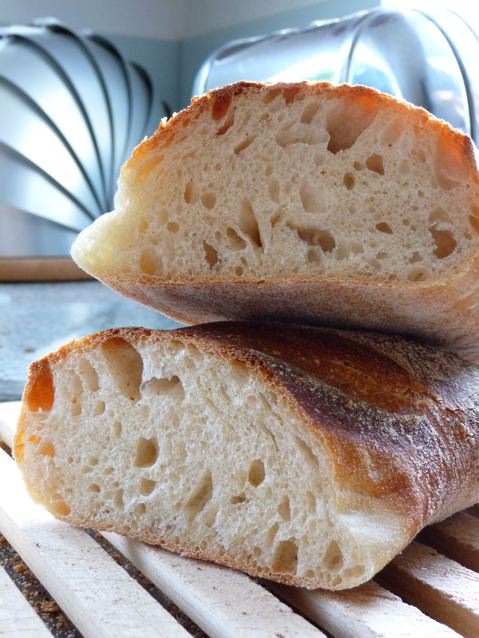
  • Mix well and serve with other salads, as a vegetable side dish, on its own with a hunk of crusty homemade sourdough baguette!
The original recipe for this in this month’s Waitrose magazine by the way which is a really good one and well worth getting hold of a copy. Their website doesn’t do the magazine justice.
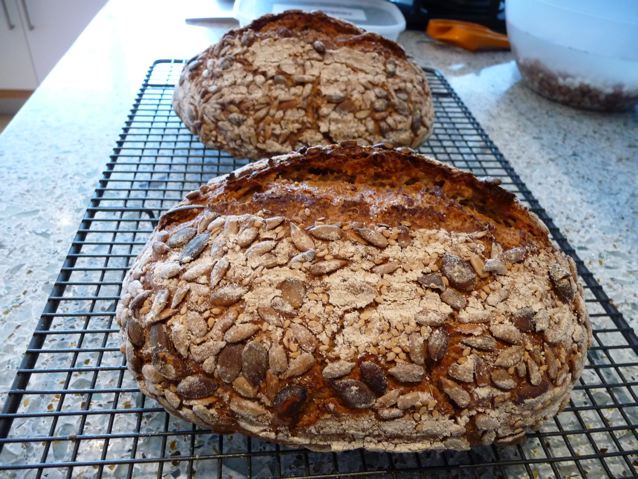
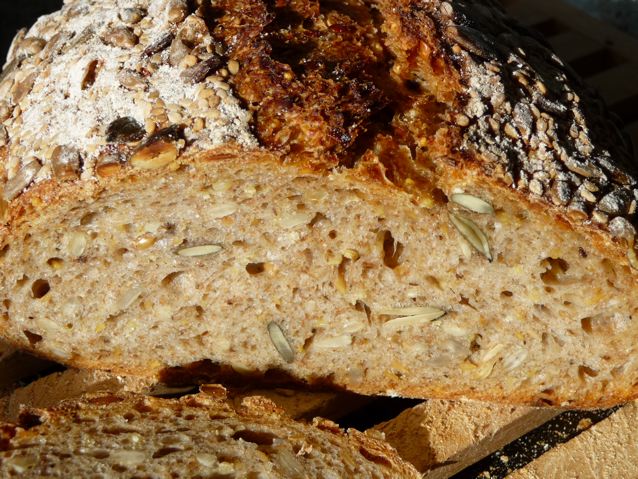
Using baked bread as a soaker in a mixed rye and grain bread

I got this nice email this morning from Andrew Auld who I know from Dan Lepard‘s bread forum.

Thought of you recently as we had a trip to Copenhagen (Andy’s blog post) and had some great rye bread. Still thinking of trying out a danish rye recipe as our rye breads do sell well. Will have to try the soaker recipe you referred to .. .

do you have a link?

I hope this is the one you are thinking of…

This bread requires both a cold soaker and a sourdough leaven

Cold Soaker

  • 50g baked rye bread (or ryvita if you have no old bread- by old bread I mean bread that is maybe 3 days old, hard but not mouldy of course, rye breads tend to age very gracefully and you can always put the end of a good loaf in the freezer with this bread in mind)
  • 25 g linseed
  • 25g millet
  • 20 g malted rye grains  or any cracked smallish grain you have that you like
 – these are small pieces of rye that have been malted by the mill (in this case Shipton Mill in England)
  • 165g water

Extra thoughts eighteen months on….To make the cold soaker, slice the bread thinly and cut into small fragments and put together with the seeds in a bowl, cover with the water and leave for 12-16 hours. If it feels very lumpy then I recommend whizzing the mixture with one of those handheld whizzy things or in a food processor to break up the lumps of bread.  If you are someone with many bowls, you could make two cold soakers, one with the bread and one with the seeds, and distribute the water between them. If you bake the slices of bread till they are golden brown before soaking, you will increase the umami flavour of your final bread.

Starter

  • 30g mature rye leaven
  • 200g lukewarm or room temperature water
  • 225 g dark rye flour (whole rye flour)

Make both the above at the same time,  12 hours plus before you want to mix the dough

For the dough

Mix both the above together. I use an electric hand mixer to do this.

Then add:

  • 370 g strong white flour
  • 105 g water
  • 15 – 20 g salt
  • 150g worth of toasted pumpkin and sunflower seeds
  • 1/4 teaspoon of easy bake yeast (optional)

Makes a quite sticky dough. Leave for 10 to 20 minutes. Do a quick knead and then leave it alone. It becomes less sticky after a while.

If you use the yeast, bulk ferment for about an hour and then scale and shape and leave to prove again for another 1 – 2 hours depending on dough temperature, room temperature etc. If you don’t use the yeast, then it will take longer of course.

I put seeds in the bottom of the banneton but you can mist the top of the dough and sprinkle seeds on top just before baking.

Slash the loaf well!

Oven temp 230 º C  for 10 minutes with steam in the oven (little tray in bottom with boiling water in)  turned down to 220 º C once the loaf has sprung and started to go brown for 20 minutes and then 210 º C  for the last 15 – 20 minutes.

Looks like Andrew liked it :) See pingback below! And this is his emailed comment:

…Definitely a deliciousness to the rye bread which I think is down to the umami effect of the old bread you mention on your blog.

Used some of the 100% rye loaf we do inspired by your recipe on dan’s blog. It has pumpkin seed and orange in it. Will be making it again for sure.

And here is Andrew’s bread ready for sale!   here

Dan Lepard’s Chocolate, Stout and Raisin Slice

[Edited to take out links which are now ‘dead’]

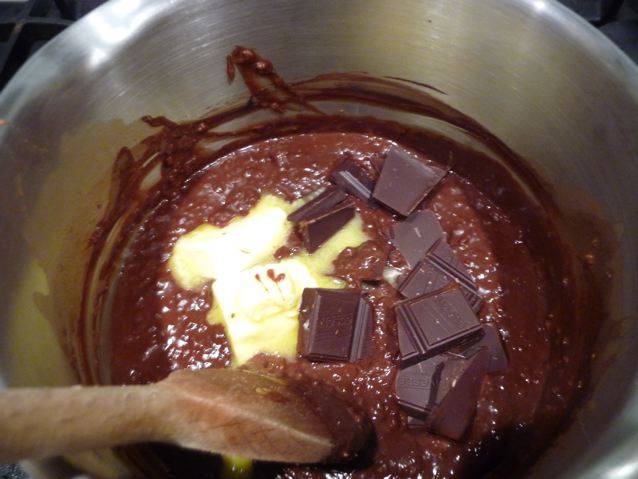
I never hear the call to make things that involve coconut, that’s because I don’t have it in the cupboard. However I do have  chocolate, cocoa, flour, golden syrup, vanilla, butter, oats, raisins, egg, soft brown sugar, and one tin of stout left over from bun making – yes, all present – so I don’t have to go shopping for some obscure ingredient.

It’s not that I like chocolate…

This is the first time I have mixed a cake entirely in a saucepan; so the kitchen was disappointingly tidy all the way through, unlike when I make bread.

Mackeson’s stout is a classic, sweet and creamy black beer made with milk lactose and whey.  I Googled it to find out what was in it.  Wikipedia inform me that is why there is a milk churn on the tin. I never notice things like that unless they are pointed out to me; I thought it was a rook from a chess set.

It feels a bit crazy pouring a can of beer into a saucepan and boiling it up with oats and cocoa as the first stage of a cake – cocoa beer porridge – reminded me of Babette’s Feast where the sister is making ale-bread soup.  But I have already used stout in Dan’s new Easter bun recipe so I was on familiar territory.  I am quite proud of my home made vanilla essence, something I learnt from Celia at Figjamandlimecordial which also features in this slice.

What’s it like?  It is  soft and moist with the oats and the stout, not as dense as you might think either, goes very well with a nice cup of tea on a sunny but chilly Friday afternoon. The cake part is chocolatey, juicy with raisins, creamy….and not too sweet – I am not good at describing taste but I am sure you get the idea. The icing is sweeter, as icing should be, but you could always make a different icing if you want less sugar.  I am not going to write out the recipe here, it is only a click away after all! [Edit: this recipe is no longer available on the internet as far as I know, if I see it in a new Dan Lepard book I will update again]