 When I lived in London, I used to pick a lot of wild mushrooms, the parks, and the Surrey woodlands were full of them.
My mother was good on identification, my aunts and uncles too, the knowledge passed on from one generation to another, backed up by books and photos. I have some, not altogether reassuring, memories of my female relatives arguing over a particularly luridly coloured specimen, saying,
‘Of course, this is a good one! ’
and then to my horror, chewing little bits and pulling faces and spitting them out….
…anyway, all I can say is that no one died and no one got ill, though I have met plenty of people who claim to know someone who knows someone who died of eating mushrooms. Of course, there are headline grabbing deadly mushrooms, like the Destroying Angel – what a name! And there are mushrooms that will make you very sick and people do die from eating them every year. You can look up the statistics on these things, though what they don’t say is how many people safely and responsibly pick wild mushrooms each year.

If you want to pick mushrooms you need to find someone to show you which ones are good and far more importantly which ones are bad and also which ones have look-alikes that can be confused. You need to read, study, and observe. There are maybe a dozen ‘good’ mushrooms that I am certain of; any I don’t know I leave them where they grow. There are books, on-line resources, fungi groups, all sorts of places to find out more. Take your time and do your homework.
In some European countries you can take your mushrooms to be identified by an expert before eating them, as far as I know we don’t have that service here.
 A few days ago walking the dogs in a glade of larches, we found these little beauties, called larch boletus or sulleius grevellei …… They only grow under larch trees; hence the name. Of course other fungi grow under larch trees, so you need to know the other characteristics of the mushroom as well. We picked a pound of them and took them home, where I cleaned them up, double checked my identification with Roger Phillips and various other reliable references and made duxelles with them as in Antonio Carluccio’s A Passion for Mushrooms.
Duxelles are a very simple way to store and freeze all mushrooms: slice some onions, fry them gently, add a little nutmeg if you like it and then add the cleaned and sliced mushrooms and cook them gently. Once the liquid has evaporated, you let them cool down and then either chop them finely and freeze in an ice cube tray so you can pop them in a bag and use them to enrich soups and stews, or just freeze them as they are. Some mushrooms dry well or can be pickled but Carluccio doesn’t recommend that for the larch boletus. This mushroom is good, but not one of the greats like porcini or morels!
So I put some in the freezer for a risotto in a few weeks time, and kept a few to go with our dinner adding a little garlic, lemon juice, parsley and cream. The sweet and earthy aroma of these mushrooms is like nothing else….together with a few of our tender garden charlotte potatoes, a piece of locally raised sirloin steak from Cotswold Edge Farm, some bright and joyful english runner beans. That was a great supper!
Do you have any special dishes you like to make with mushrooms?

 Do you remember I picked all those sloes and bullaces and a few damsons in the autumn? And had my first go at making sloe gin? Did I tell you that after making two jars of that someone who lives in my house said he didn’t like gin and could we do some with vodka? I really can’t remember what I told you…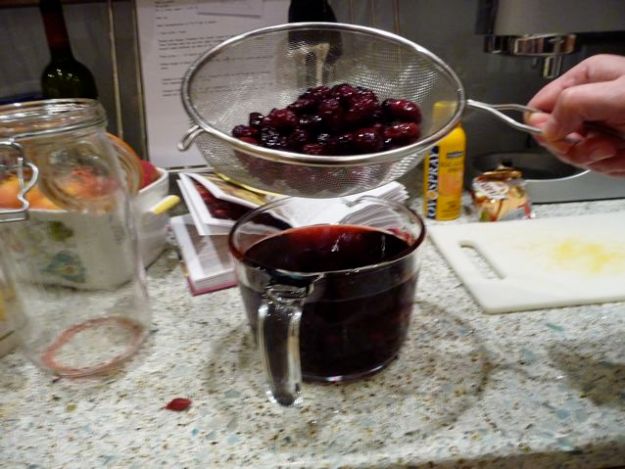

 Zeb Bakes